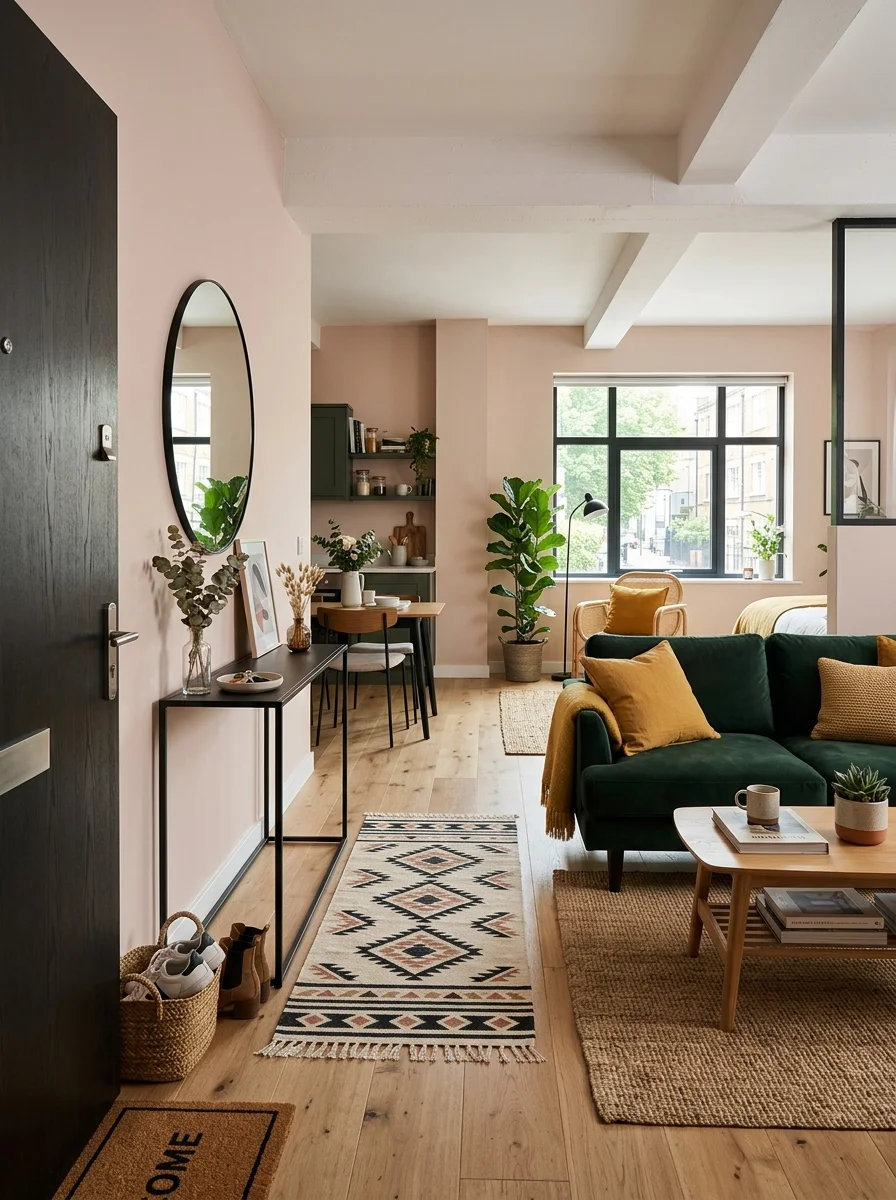
Your Apartment Entrance Sets the Tone for the Whole Home
Apartment entrances often have an awkward reputation.
They may be little more than a strip of wall beside the front door, a narrow hallway, an overlooked corner, or a door that opens directly into the living room.
That does not mean the entrance has to feel unfinished.
A well-designed apartment entryway does not need a grand foyer. It needs a clear place to arrive.
That might be a slim console, a bench, a mirror, a few hooks, a shoe cabinet, or simply a small surface where keys and bags naturally land. For more ideas tailored to compact entrances, see our guide to small entryway ideas.
The important part is that the entrance should support the natural transition between outside and inside:
- You come home.
- You put something down.
- You take off your shoes.
- You hang your bag.
- You glance in the mirror.
- You move into the rest of the apartment.
When those daily actions have somewhere intuitive to happen, even a very small entrance feels deliberate and calm.
First Decide What Kind of Apartment Entrance You Have
Before choosing furniture or ordering storage organizers, identify the basic architectural shape of your entrance:
- The Tiny Foyer: You have a small defined alcove or recess immediately inside the door.
- The Hallway Entrance: The front door opens into a long corridor leading toward the living areas.
- The Open-Plan Entrance: The front door opens directly into an open living room or dining area.
- The No-Entryway Entrance: There is effectively zero transition zone between door and living space.
- The Rental Entrance: Restrictions apply on drilling walls, painting, or altering hard fixtures.
Each situation calls for a slightly different design strategy. The most common mistake is attempting to recreate a traditional suburban foyer where the architecture simply does not provide one.
The Apartment Entryway Formula
A functional apartment entrance often needs only four core layers:
- Landing: Somewhere for keys, mail, and everyday pocket items.
- Storage: Somewhere for shoes, bags, or outerwear.
- Reflection: A mirror or artwork that gives the wall visual purpose and reflects ambient light.
- Light: Enough illumination to make the threshold feel warm and welcoming after dark.
Not every entrance requires all four in separate freestanding pieces. A mirror can sit directly above a shallow console. A bench can incorporate lower shoe storage. A set of vertical wall hooks handles outerwear. A small table lamp creates atmospheric warmth.
The objective is to solve multiple functions without overcrowding the entrance with furniture.
1. Start With a Slim Landing Surface
A slim console table is one of the easiest ways to establish an entryway where the architecture does not provide one.
The most critical dimension is depth.
You need enough surface depth for keys, a small lamp, or a decorative ceramic dish, but not so much that the piece encroaches on circulation. In a narrow apartment entrance, a console with a depth of 8 to 11 inches establishes a visual boundary without blocking the hallway.
If storage is needed, choose a design with shallow pull-out drawers rather than cluttering the floor with separate bins and caddies. One well-designed, proportioned piece can do far more than several small accessories.
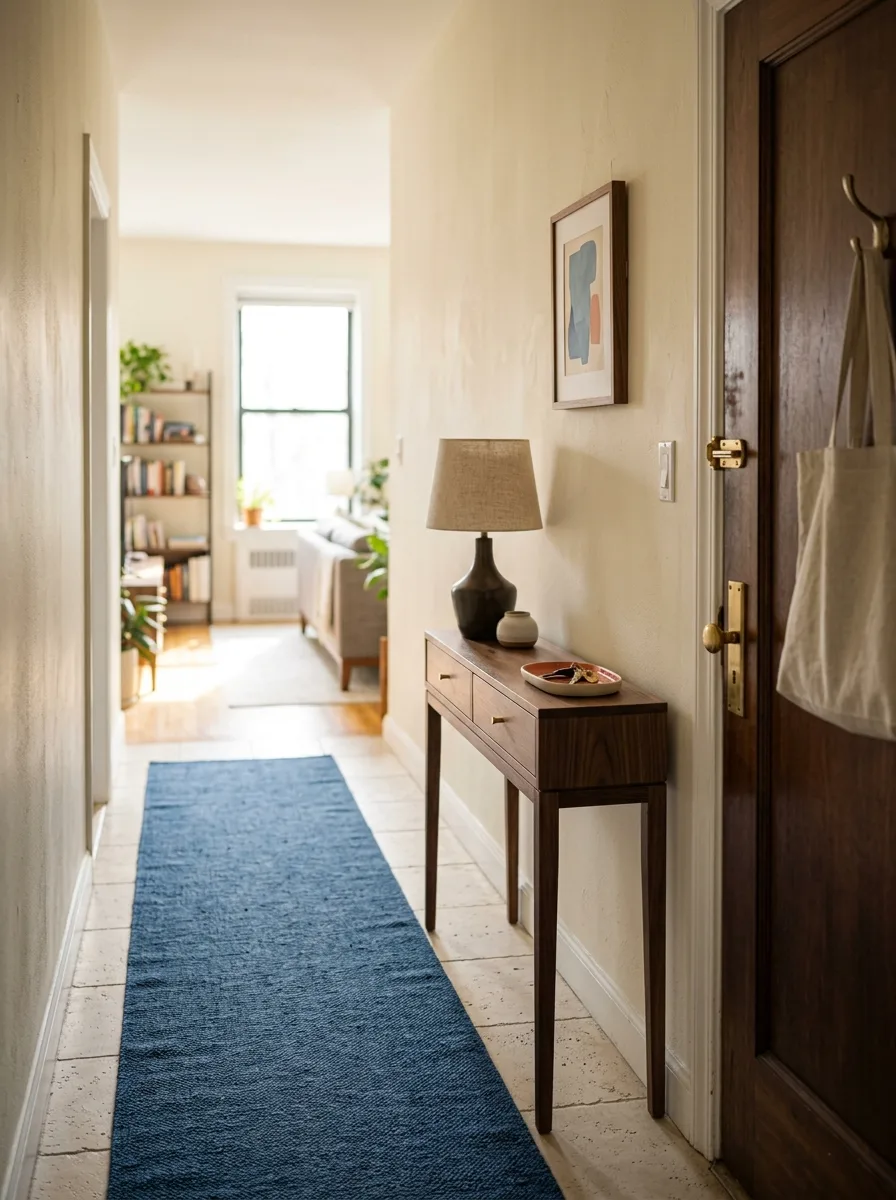
Design Tip: Floating wall-mounted consoles are ideal for tight spaces because keeping the floor beneath exposed makes the entire entrance feel visually lighter.
2. Use a Mirror to Create a Visual Pause
A mirror is especially valuable in apartment entrances because it delivers high functional and visual utility without taking up a single square inch of floor space.
It gives a blank wall an intentional architectural focal point, reflects light from adjacent living spaces into often windowless hallways, and provides a convenient spot for a final check before heading out.
The most natural position is centered above or near the main landing surface.
However, avoid treating the mirror as a gimmick to fool people into thinking the apartment is huge. Its primary purpose should be practical and decorative. Any increase in perceived brightness and depth is a welcome bonus.
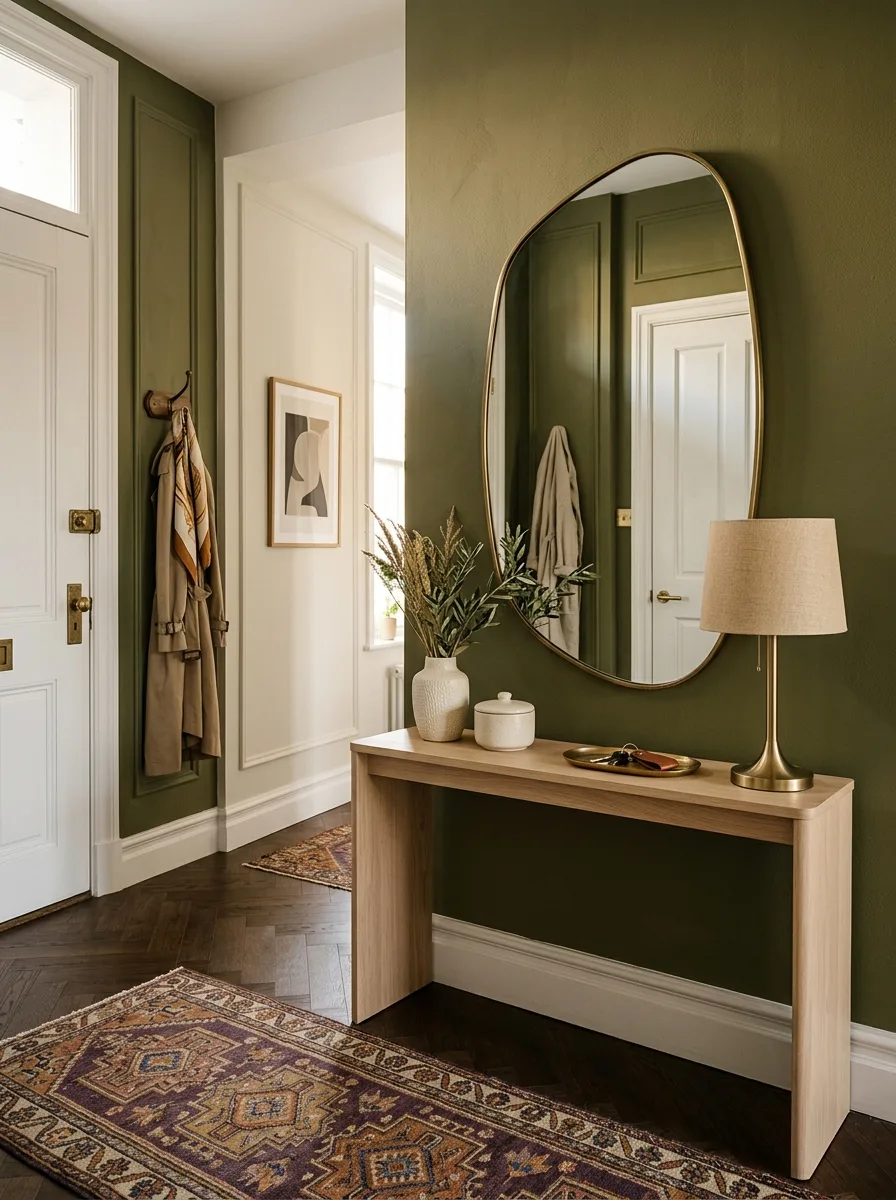
Styling Advice: An arched or circular mirror softens the rigid rectangular lines of apartment doorways and corridor walls.
3. Give Shoes a Defined Boundary
Shoes become visually chaotic the moment there is no obvious boundary for where they belong.
A small apartment does not need a massive wardrobe cabinet. It simply needs a strictly defined perimeter.
That boundary could be:
- One low wooden slatted shelf
- Two woven baskets beneath a console
- A ultra-slim tilt-out shoe cabinet
- A compact storage bench
- A low brass or rubber boot tray
The essential step is deciding how much footwear belongs by the front door. The entrance should hold only the pairs worn on a daily basis. Seasonal and occasional footwear should be stored in bedroom closets. For comprehensive shoe organization, browse our entryway shoe storage ideas.
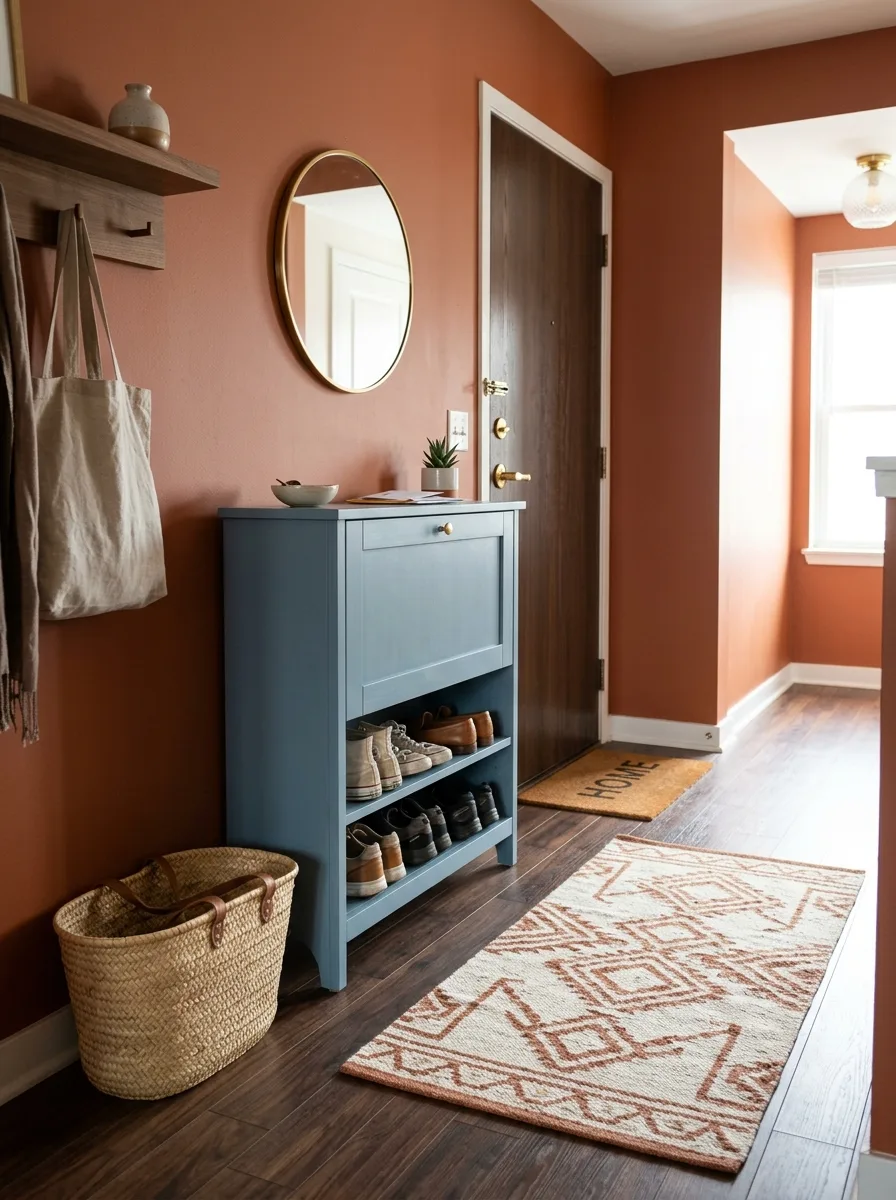
4. Add Hooks Before Adding a Coat Cabinet
Apartment entrances frequently have substantially more vertical wall space than usable floor square footage. Take full advantage of it.
A short row of sturdy wall hooks can hold everyday bags, jackets, umbrellas, and hats without requiring a bulky freestanding wardrobe.
Keep the number of hooks proportional to the household. Too many hooks encourage the entrance to become permanent storage for every piece of outerwear you own. Four to six well-spaced hooks remain disciplined, while twelve invite an unmanageable pile.
For additional coat and gear strategies, read our guide on entryway storage ideas.
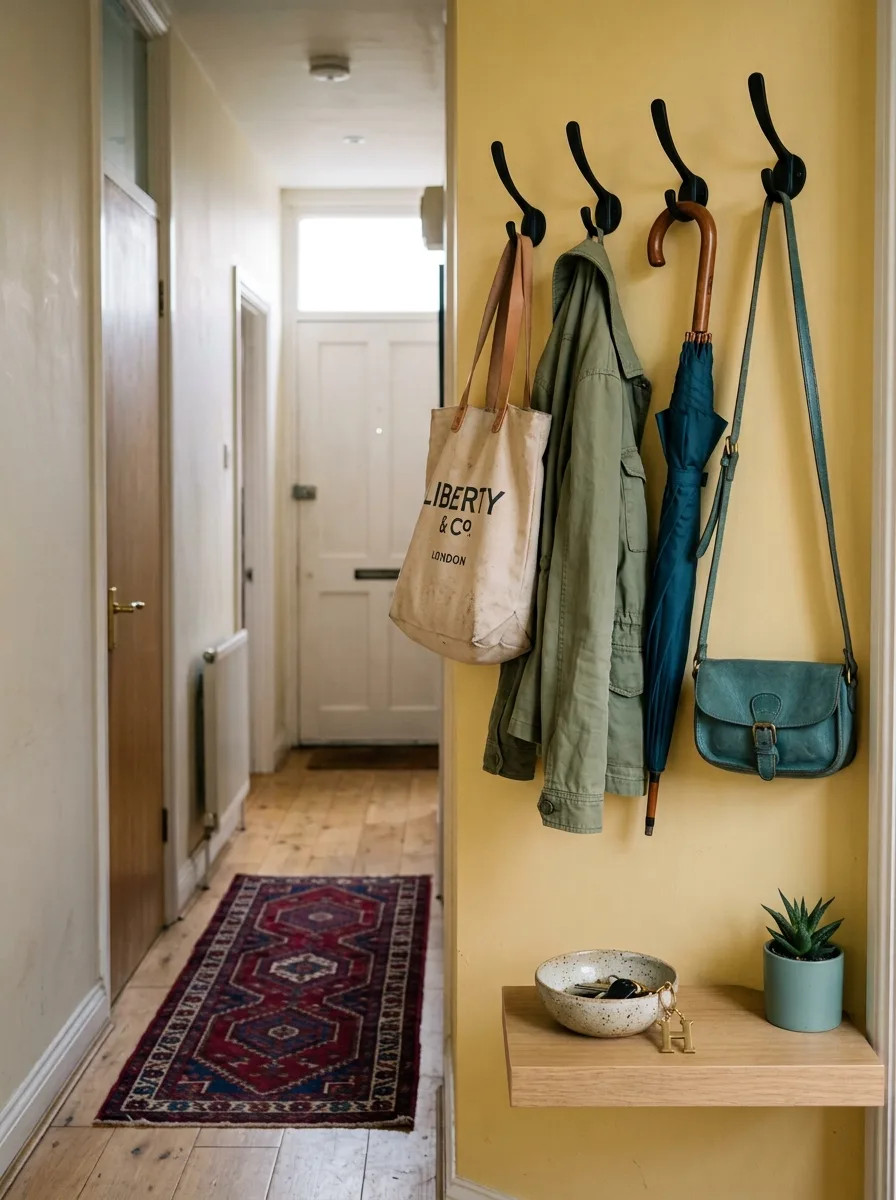
Proportion Rule: Space hooks 6 to 8 inches apart. Staggering two rows vertically doubles storage capacity on a narrow wall without crowding garments.
5. Create an Entryway Even When There Isn’t One
If your apartment front door opens directly into the living room or open-plan layout, you can still establish an authentic sense of arrival.
Use furniture placement and visual cues to demarcate a dedicated zone:
- Console + Mirror + Runner: Anchors the entry wall immediately beside the door.
- Low Bench + Hooks + Framed Art: Creates a welcoming seating niche without vertical bulk.
- Shoe Cabinet + Mirror + Wall Sconce: Provides closed storage and warm illumination.
The entrance becomes a recognizable transition area without requiring drywall partitions or construction.
A narrow rug is particularly effective here because its edges draw a crisp visual boundary right on the floor.
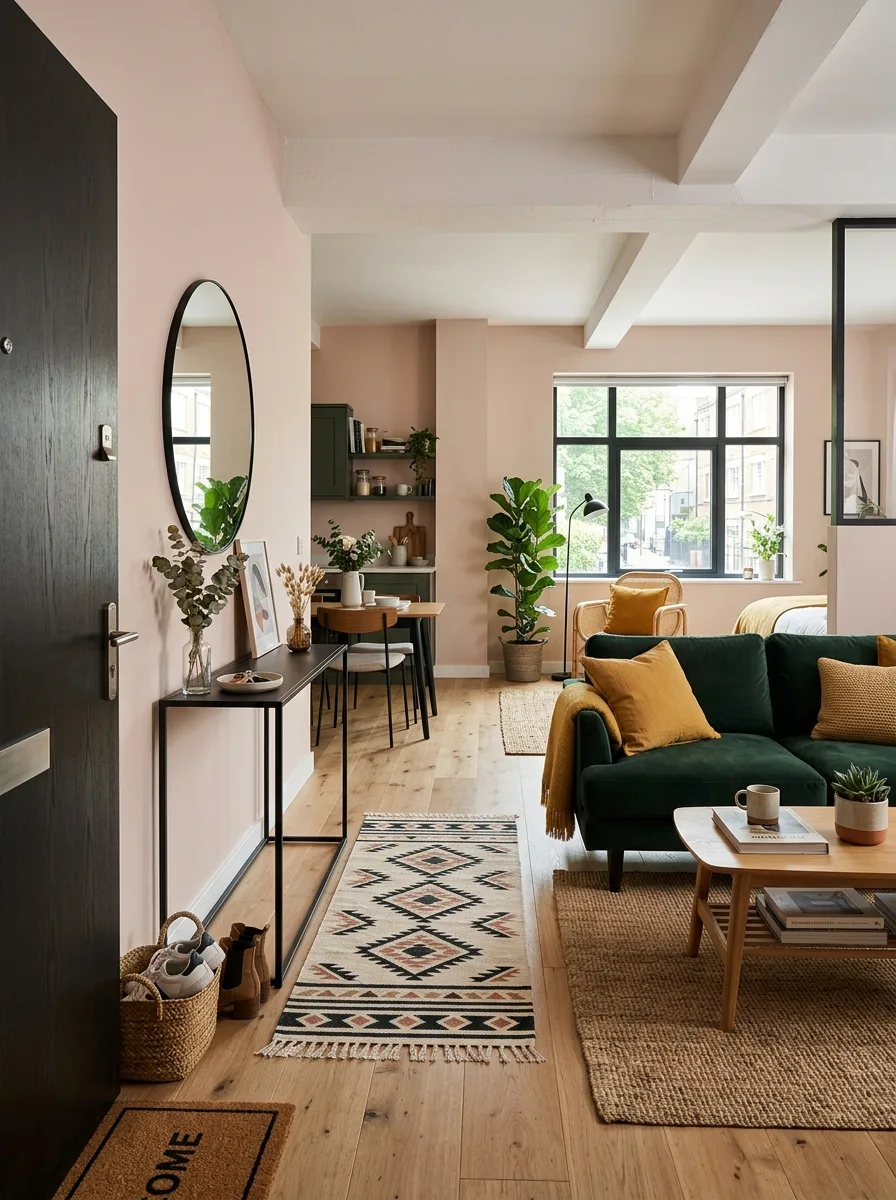
6. Let the Entryway Share Furniture With the Living Room
In compact homes, furniture does not need to halt at imaginary room borders.
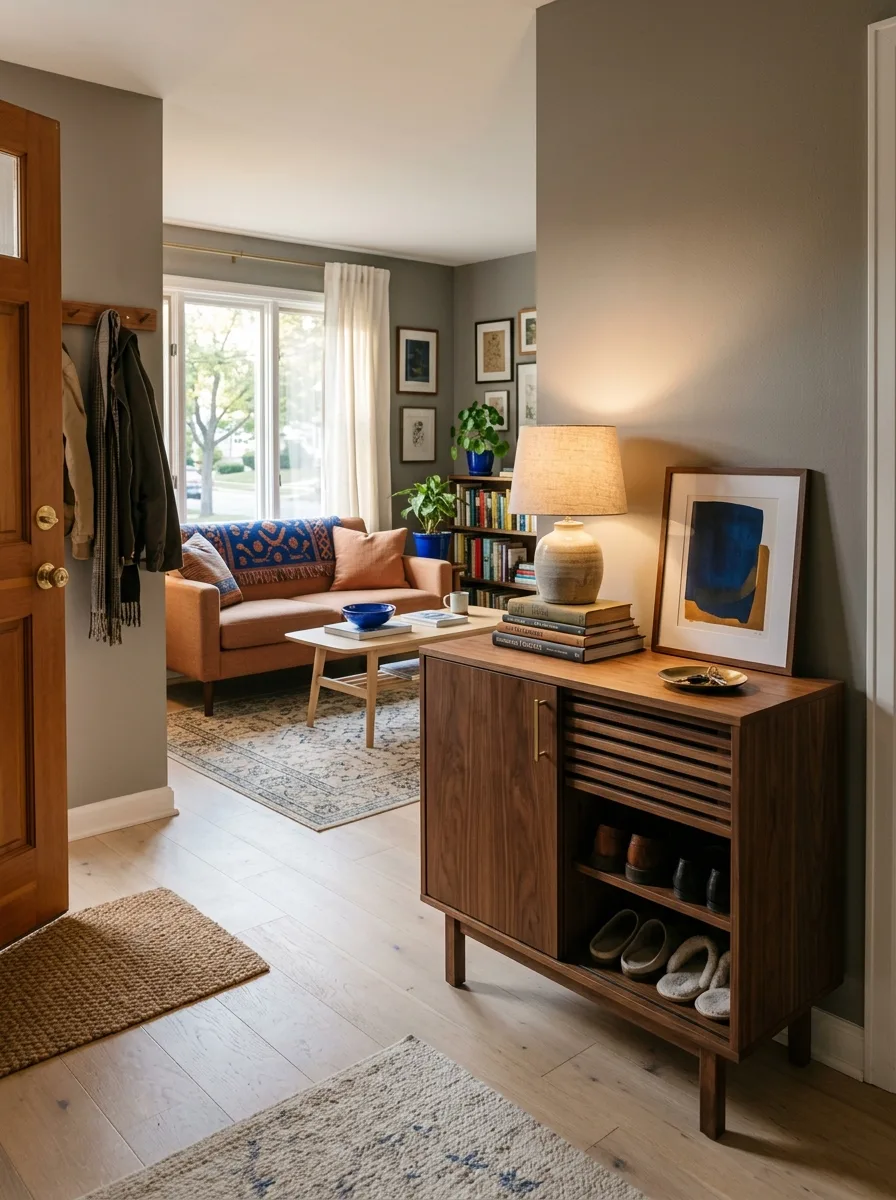
A console table placed near the front door can serve as the entryway drop zone on one side while holding living room lighting and book displays on the other.
A sturdy low bench can provide seating for slipping on boots during the morning rush, and slide into the living area as extra guest seating on weekends.
Similarly, a low credenza can house entryway shoe storage behind one door and board games or media behind the other. This integrated approach prevents the entrance from feeling like a miniature room demanding duplicate furniture. Explore more double-duty layouts in our guide to space-saving furniture ideas.
7. Use a Runner to Establish Direction
A runner visually connects the apartment entrance with the living quarters, turning a disjointed corridor into an inviting journey.
This is especially helpful in long, narrow hallways that might otherwise feel institutional or dark.
Choose a runner pattern that introduces warmth and texture without visually fighting with adjoining rooms:
- Flat-weave wool or durable vintage kilims offer easy cleaning and high durability.
- Low-pile rugs prevent catching on the bottom edge of doors.
Ensure adequate clearance around the rug perimeter so front doors and closet doors open effortlessly.
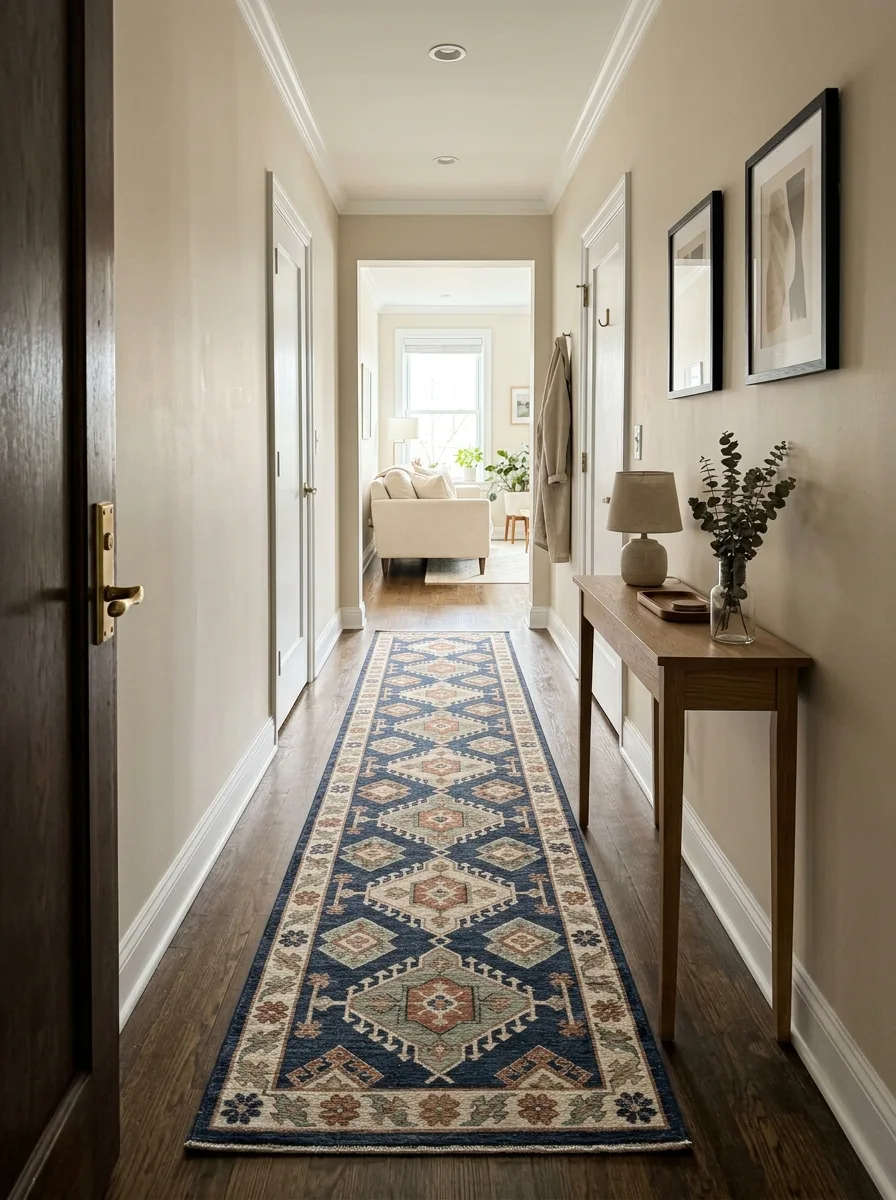
Safety & Comfort: Always install a high-grip felt-rubber pad underneath entryway runners to prevent bunching and dangerous slips on hardwood or tile floors.
8. Make the Front Door Part of the Design
The front door is typically the single largest vertical element in an apartment entrance.
Instead of treating it as visual dead space or ignoring it, allow it to participate actively in the entryway composition.
Depending on your building regulations and lease terms, possibilities include:
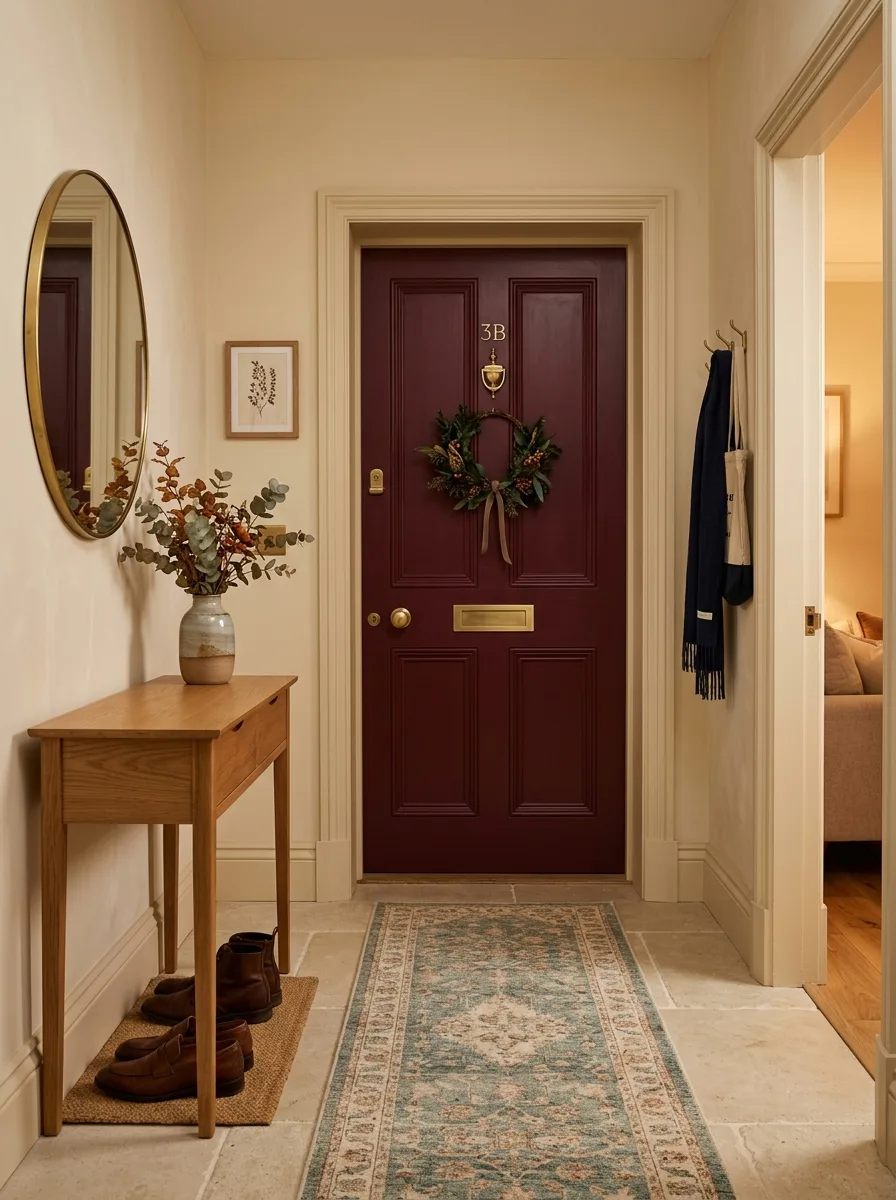
- Painting the interior side of the door a distinctive grounding hue (such as charcoal, warm taupe, or deep olive).
- Hanging a simple dried eucalyptus or boxwood wreath.
- Upgrading standard developer hardware with high-touch brass or matte black handles.
- Adding elegant brass house numbers or an interior key hook.
For renters who cannot paint or drill into the door, framing the wall perimeter around it creates equivalent character.
9. Create a Small Everyday Drop Zone
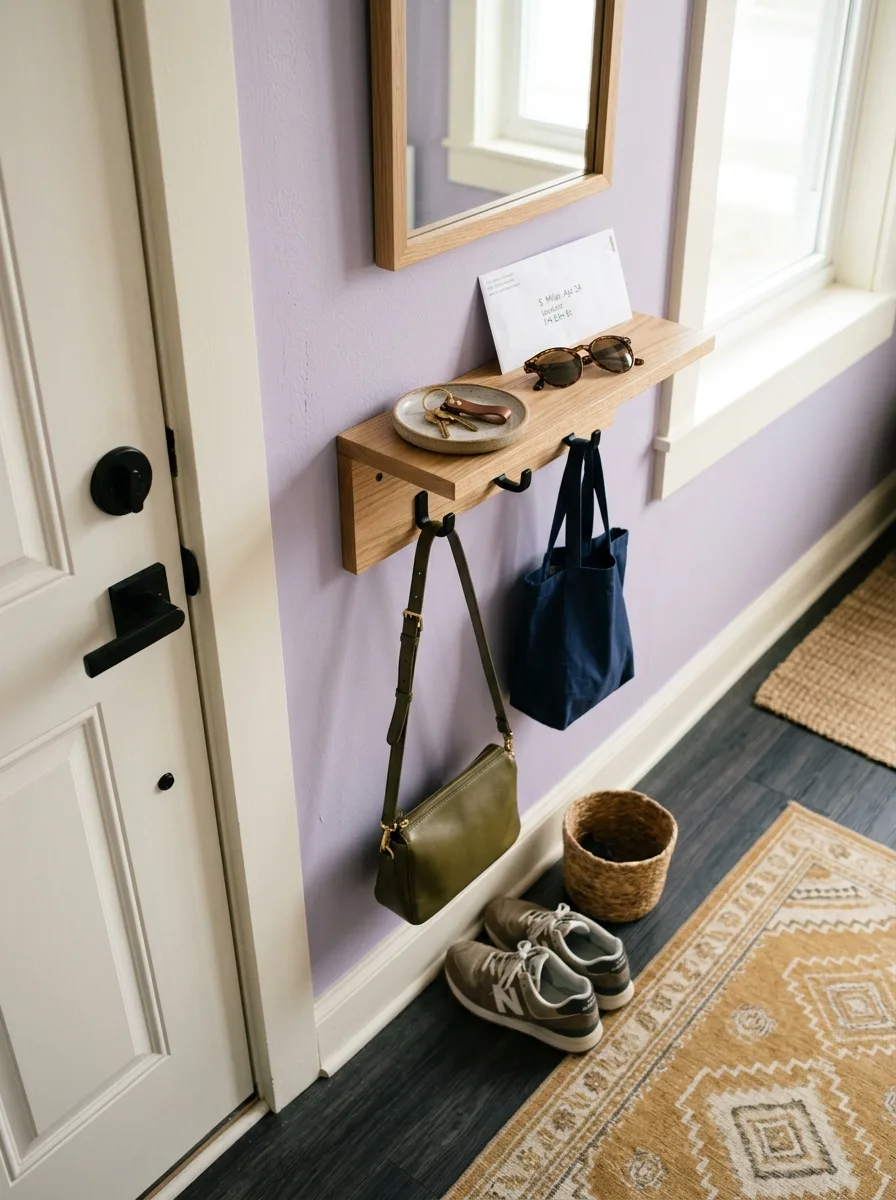
A drop zone does not need elaborate modular joinery. It simply needs to deliver clear, instantaneous answers to three questions:
- Where do my keys and sunglasses go?
- Where does my daily bag land?
- Where does today’s incoming mail sit?
A shallow wall-mounted ledge with a ceramic tray can be more than enough. When floor space is at a premium, an all-in-one wall organizer keeps the floor totally clear.
The key to long-term success is consistency: when everyday items always have a dedicated home, entrance clutter never has a chance to accumulate. See our system recommendations in apartment organization ideas.
10. Use a Bench When the Entrance Has Enough Width
If your apartment entrance has sufficient depth, a bench creates the ultimate welcoming arrival point.
It provides a comfortable seat for taking off shoes, offers space for baskets or shoes underneath, and grounds the wall with horizontal balance.
However, never force a bench into a narrow corridor that cannot comfortably accommodate human traffic.
Always measure the remaining walking path after the bench is in place. A beautiful upholstered or wooden bench quickly becomes an annoyance if people must turn sideways to squeeze past it.
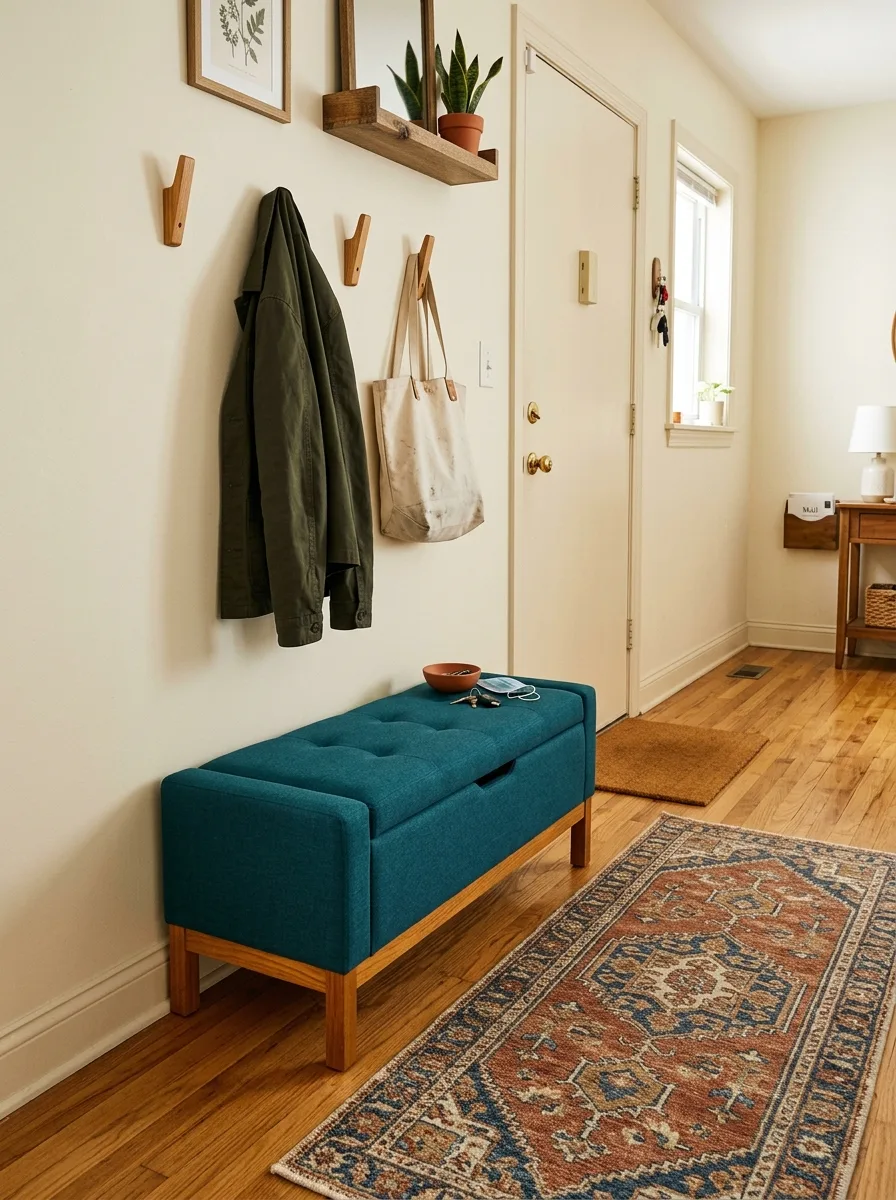
Clearance Guide: Maintain a minimum 32-to-36-inch walking corridor between the edge of your bench and the opposite wall.
11. Use a Tall Cabinet When Floor Width Is Limited
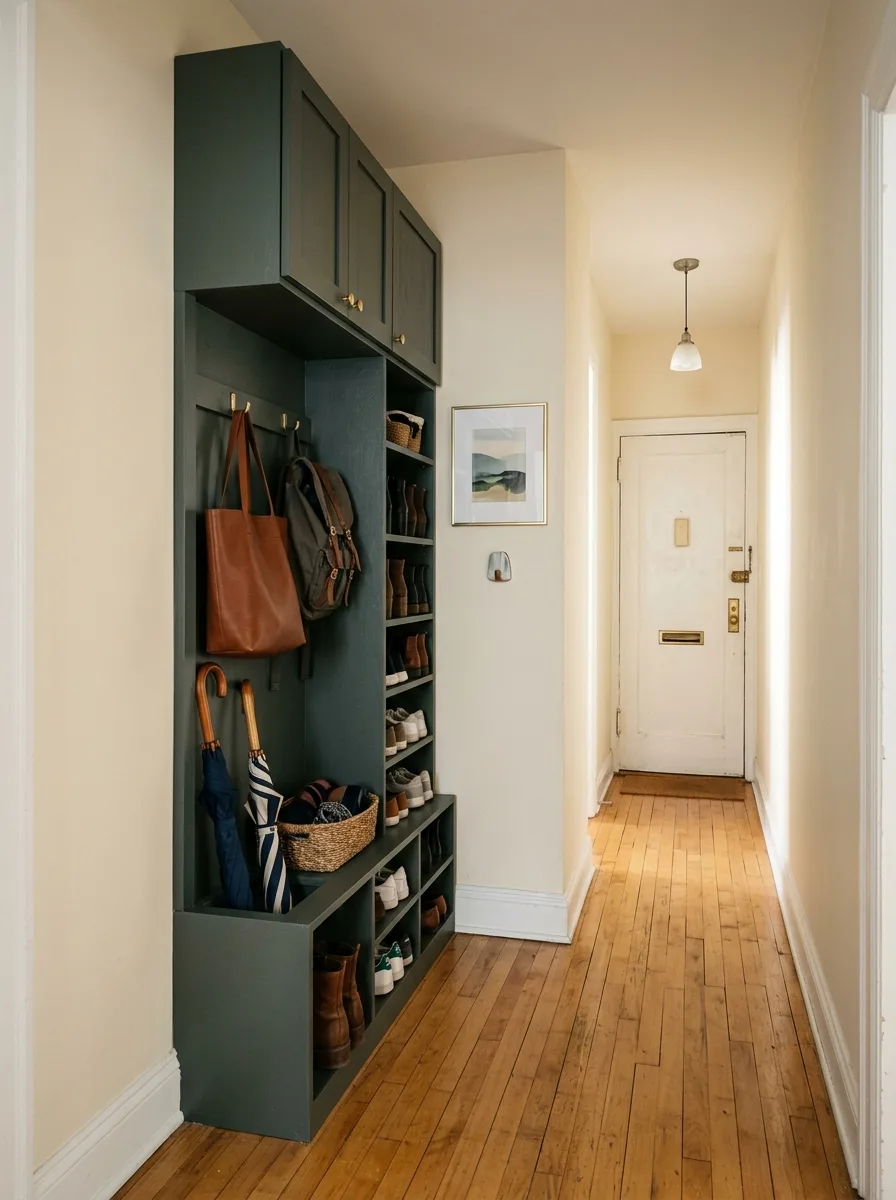
When horizontal floor space is scarce, building upward is the smartest storage move.
Instead of a wide console or long credenza, consider a tall, shallow cabinet. A vertical footprint of just 14 inches deep and 24 inches wide can organize:
- Everyday bags and backpacks
- Daily and secondary shoes
- Umbrellas and hats
- Cleaning tools or vacuum accessories
- Seasonal scarves and gloves
Because the doors close completely, all everyday visual noise remains neatly hidden behind closed panels.
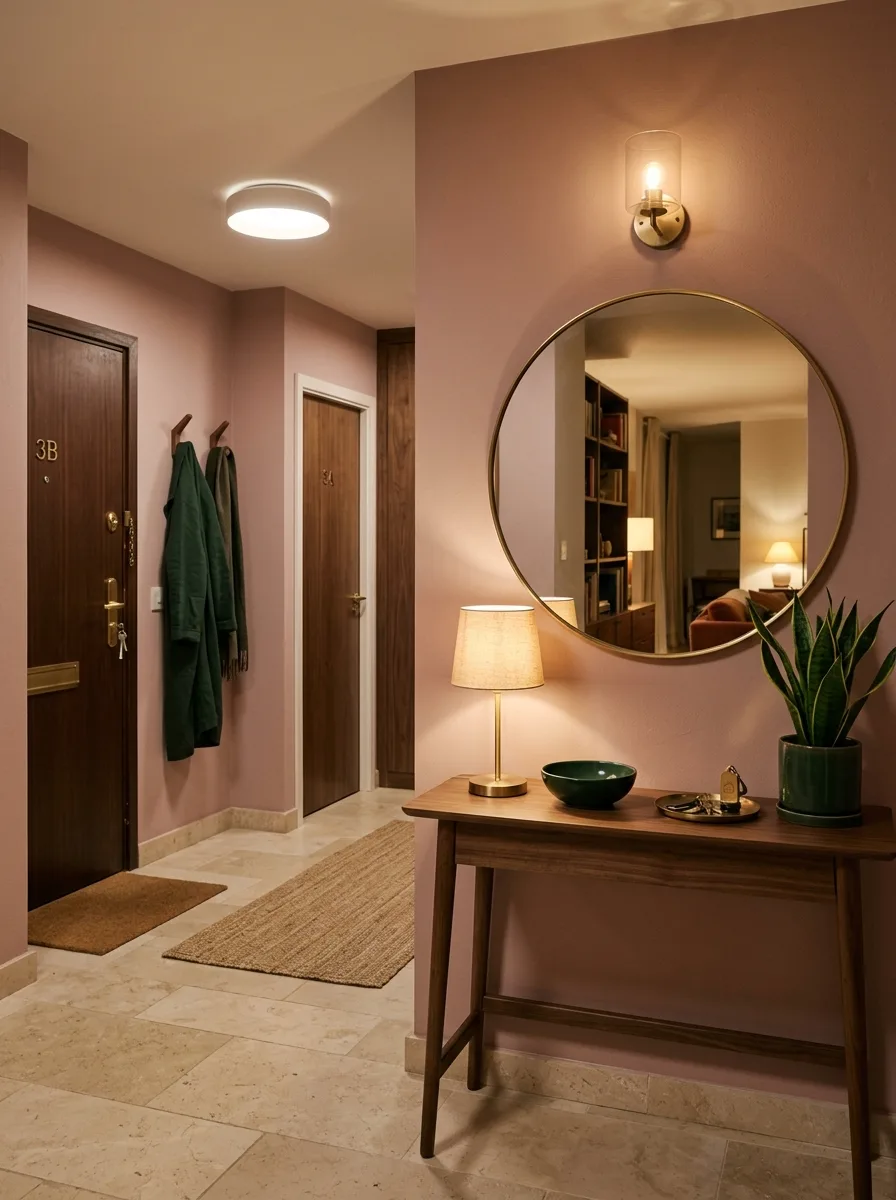
12. Use Lighting to Make the Entrance Feel Intentional
Many apartment entrances suffer from harsh overhead lighting. A single utilitarian ceiling fixture often casts unflattering shadows and feels sterile.
Whenever possible, introduce a second layer of ambient lighting:
- A compact table lamp placed on a console table.
- A plug-in or hardwired wall sconce positioned beside a mirror.
- A portable, rechargeable LED accent lamp for rental hallways lacking wall outlets.
Warm light (2700K) is especially effective because it establishes a calming emotional threshold between the frantic pace of the outside world and the peace of home.
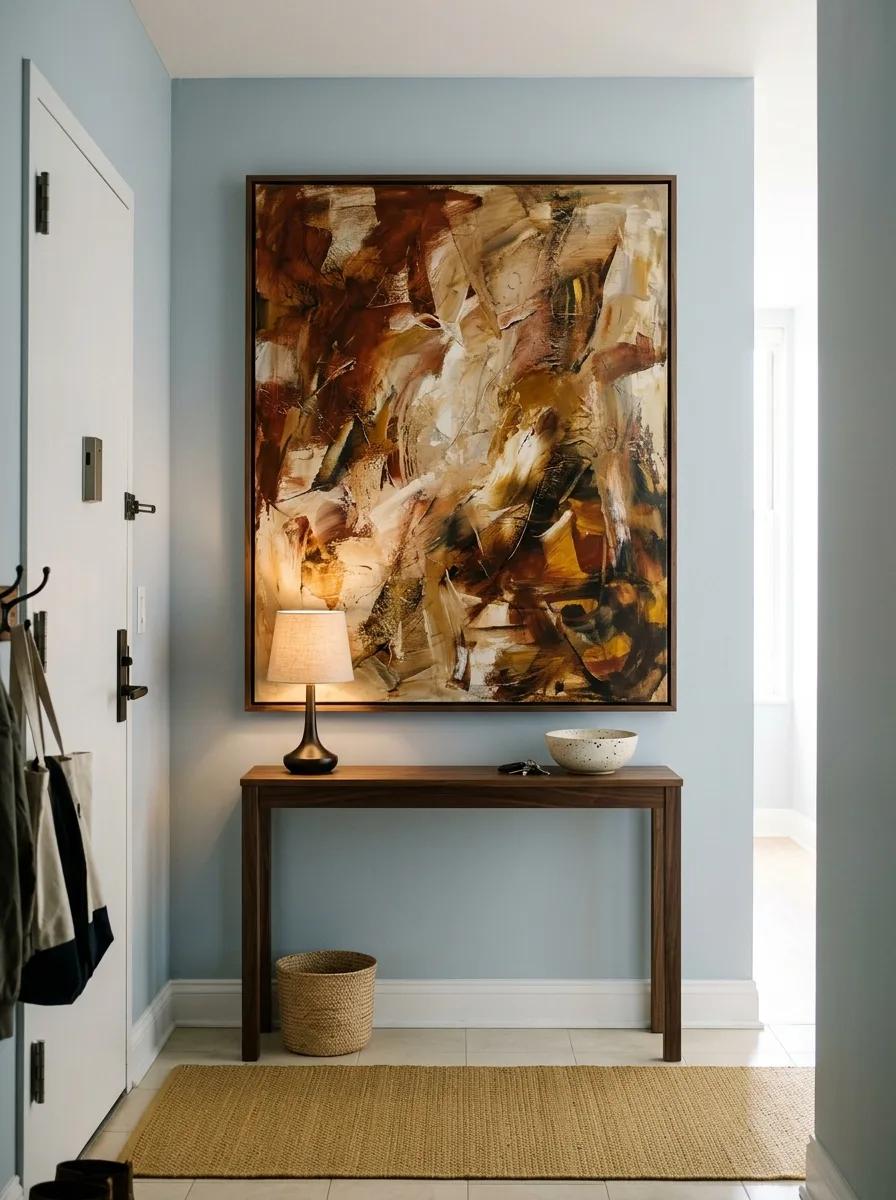
13. Give the Entrance One Strong Decorative Moment
An apartment entrance does not need a packed gallery wall, three shelves of knick-knacks, and an array of decorative trinkets.
One strong visual moment is far more memorable.
Choose one hero element:
- An oversized framed photographic or textile print
- A sculptural brass or carved wood mirror
- A distinctive ceramic table lamp
- A richly patterned runner rug
- An accent wall painted in a warm, enveloping tone
Once you install that focal piece, allow the surrounding surfaces to remain quiet and uncluttered. This restraint provides instant sophistication.
14. Use Baskets for Soft, Flexible Storage
Baskets are indispensable when you need practical concealed storage without making an apartment entrance feel rigid or overly furnished.
Place a woven wicker or rattan basket beneath a console for totes and reusable grocery bags. Position two low rectangular baskets beneath an entryway bench for shoes. Keep a tall structured basket near the door for umbrellas and walking sticks.
Natural woven textures bring organic warmth that softens hard surfaces such as tile, wood floorboards, metal fixtures, and drywall.
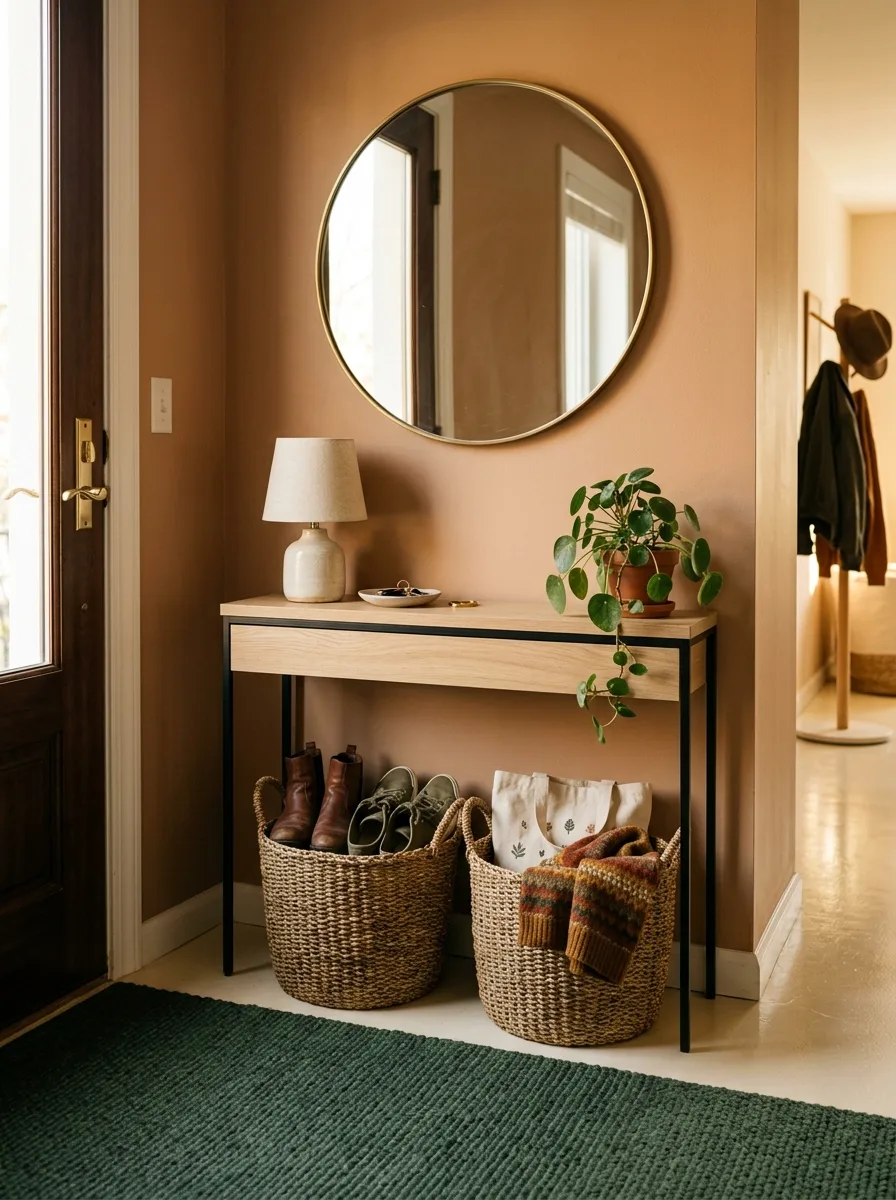
Material Consistency: Stick to one basket material—like seagrass, jute, or felt—throughout the entryway to keep the visual rhythm unified.
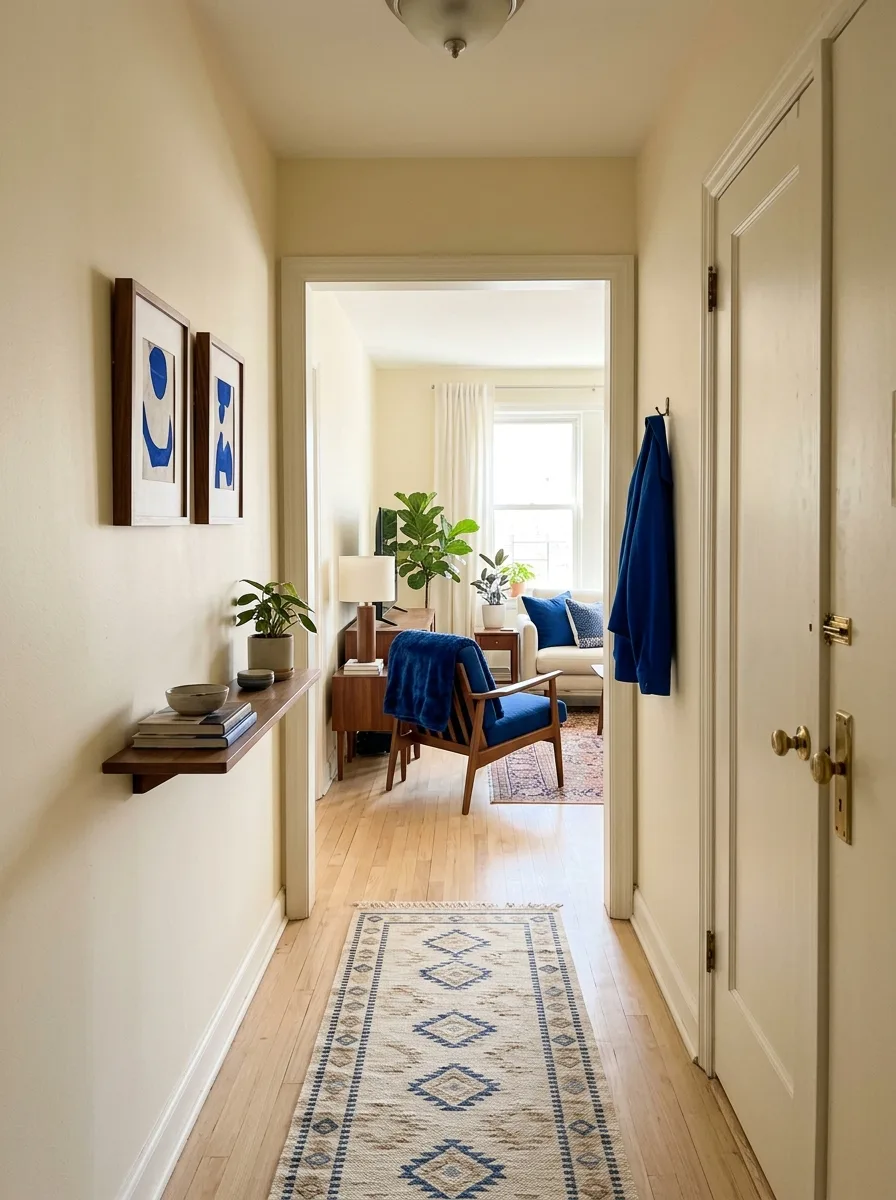
15. Make a Narrow Hallway Feel Like Part of the Home
Long apartment hallways often feel like forgotten passageways rather than integral parts of the home.
The solution is not necessarily cramming them full of furniture. Rather, connect them visually and tonally with adjacent rooms.
Repeat a key material, accent color, or art framing style from the adjoining living space:
- If your living room features walnut furniture and brass hardware, include a small walnut shelf and brass sconce in the hallway.
- If your rooms share warm neutral walls with linen textiles, carry the same paint tone and a textured runner down the corridor.
When styled cohesively, the hallway feels like an intentional prelude to the rest of your apartment.
16. Design Around the Door Swing
This is one of the least glamorous but most crucial rules of apartment entryway planning.
Before buying any furniture or hanging mirrors:
- Open the front door to its full arc.
- Measure the exact clearance from the door’s edge to the nearest side wall.
- Check where the doorknob lands against the wall.
- Mark the door swing path on the floor with painter’s tape.
Any piece of furniture that falls inside that arc will constantly get clipped, chipped, or blocked. The same applies to shoe racks, baskets, and free-standing floor lamps.
Good interior design always respects physical movement first.
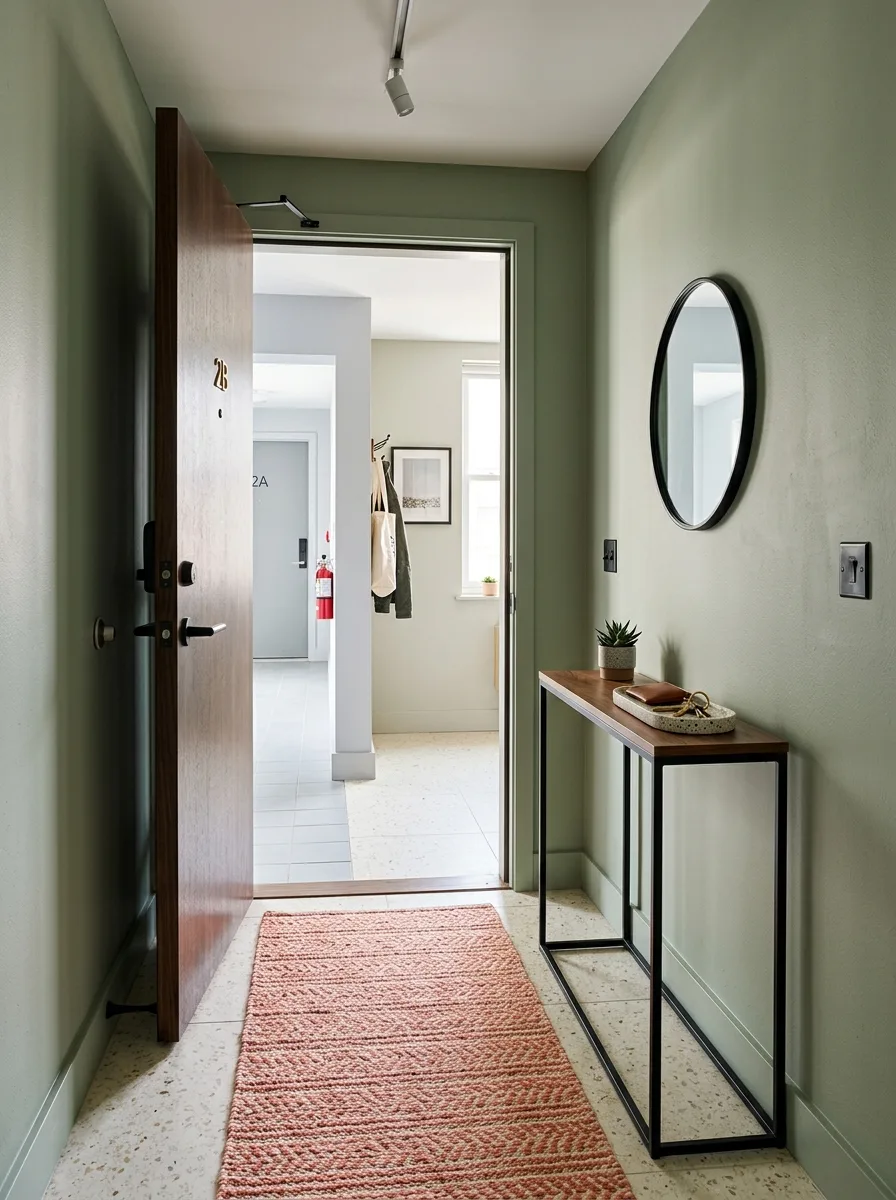
17. Create a Renter-Friendly Entryway
You do not need to drill massive holes or remodel drywall to make a rental entrance feel personal and polished.
Renter-safe entryway strategies include:
- Heavy-duty damage-free adhesive hooks for coats, keys, and bags.
- Freestanding narrow consoles or leaning full-length mirrors.
- Rechargeable, touch-activated portable lamps that require no wall wiring.
- High-quality vintage runner rugs that cover bland rental floor tiles.
- Free-standing tilt-out shoe cabinets that can be strapped to the wall with removable anchor brackets.
A rental entryway should feel curated and welcoming without risking your security deposit. Discover more flexible strategies in our guide to small space ideas.
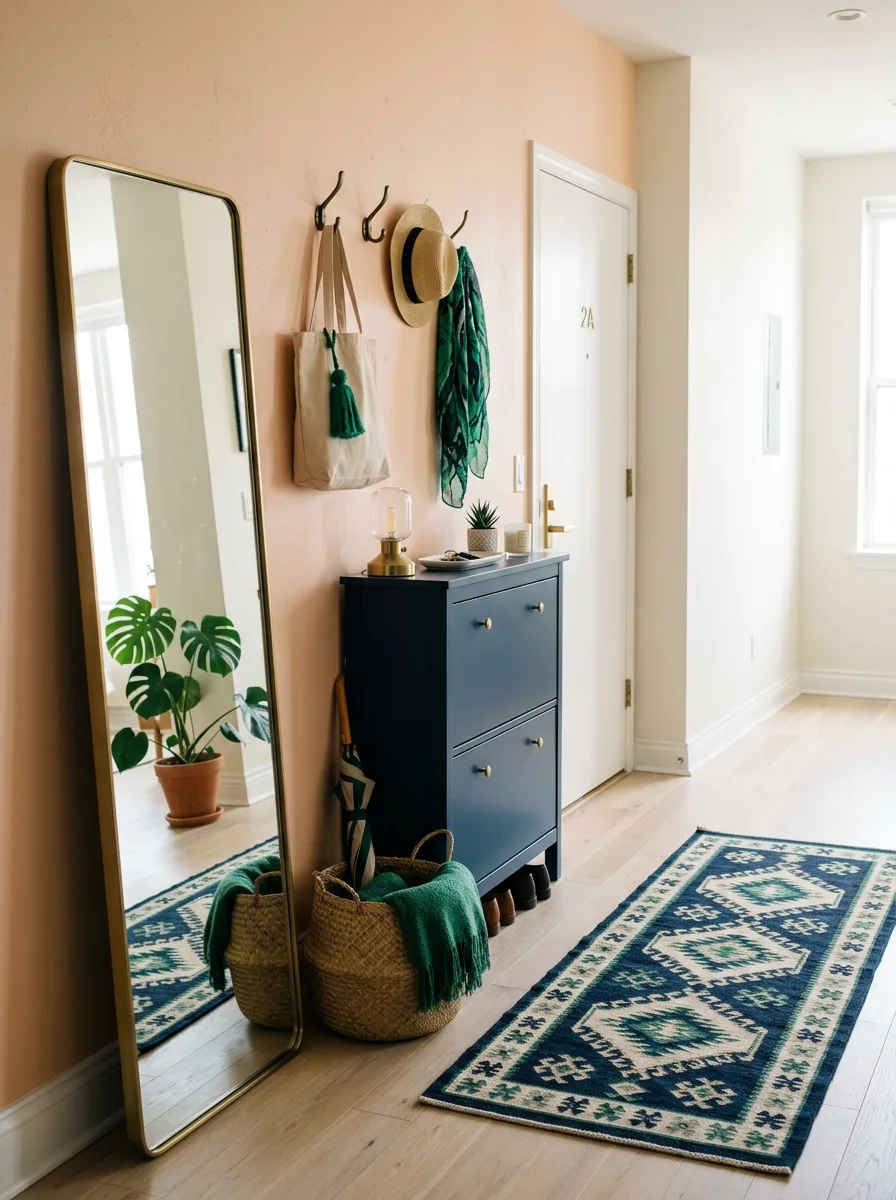
When an Apartment Entryway Is Too Small for Furniture
Sometimes the smartest design decision is to use zero floor furniture.
A tiny entrance may work better with a disciplined vertical arrangement:
Wall Hooks + Floating Shelf + Mirror + Small Tray
This keeps the floor line completely open and makes a tight space much easier to navigate:
- Eye-level mirror: Provides a convenient final glance before leaving while reflecting natural light into darker apartment hallways.
- Floating shallow shelf (4 to 6 inches deep): Establishes an intentional landing zone for keys, sunglasses, and mail without intruding on the walking path.
- Row of sturdy wall pegs: Holds everyday jackets, work totes, and umbrellas securely without the bulk of a standalone wardrobe.
- Small catchall dish: Keeps pocket change, transit cards, and small essentials gathered in one designated place.
That wall-mounted combination is often all a compact entrance needs to feel complete and functional without sacrificing an inch of floor footprint.
How to Make a Small Apartment Entrance Feel More Expensive
Elevating an apartment entrance is rarely about spending thousands on designer pieces. It is about scale, editing, and tactile materials.
A modest entryway console looks upscale when given breathing room rather than being buried in junk. A simple mirror looks custom when scaled generously.
Try combining these five complementary textures:
- One natural wood tone: An oak console, walnut shelf, or ash bench.
- One warm metal finish: Unlacquered brass hooks, an antique bronze light switch, or matte black mirror frame.
- One soft textile: A wool runner or linen cushion.
- One reflective or sculptural surface: A bevel-edged mirror or ceramic dish.
- One living element: A small vase of olive branches or a potted fern.
Then stop. Restraint is the secret to an expensive, tailored aesthetic.
Layout Dilemmas: What to Do in Awkward Entrances
When the Entrance Opens Directly Into the Kitchen
This layout is common in urban flats. Because the front door immediately overlooks meal prep areas, visual containment is vital:
- Use a closed, shallow shoe cabinet rather than open racks so dirty footwear is never visible from cooking counters.
- Hang a slim runner that visually establishes an entry path separate from kitchen work zones.
- Maintain a dedicated drop bowl on an entryway wall shelf so incoming mail never invades kitchen countertops.
When the Entrance Opens Directly Into the Living Room
Here, the challenge is creating an architectural transition where none exists:
- Position the back of a sofa or a slim console perpendicular to the front door to create a simulated foyer partition.
- Lay a durable runner that guides traffic past the seating area rather than cutting directly through the conversational cluster.
- Anchor the entry side of the room with an oversized piece of art and a warm lamp that greets you the moment you unlock the door.
Common Apartment Entryway Mistakes to Avoid
- Attempting a full foyer in a micro-space: Work with the architecture you actually have rather than forcing suburban ideas into a compact footprint.
- Buying furniture without checking door swing: Never purchase a console or bench without checking door swing clearance.
- Storing every pair of shoes at the door: Restrict entry footwear to 2–3 everyday pairs per resident; store the rest in closets.
- Overcrowding walls with excessive hooks: A wall of twenty hooks inevitably looks like a coat shop clearance rack.
- Overdecorating small surfaces: A tiny console with four picture frames, three candles, and two figurines leaves no room for keys.
- Relying solely on harsh ceiling lighting: Single flush-mount fixtures create a clinical, uninviting arrival experience.
- Using furniture with excessive depth: Anything deeper than 12 to 14 inches usually overwhelms an apartment corridor.
- Disregarding design continuity: An entryway that clashes in color and style with the adjacent living space makes the whole home feel fragmented.
The 5-Minute Apartment Entry Reset
A successful entryway should be effortless to maintain. Incorporate this 5-minute evening routine:
- Shoes away: Return everyday shoes to their cabinet, bench shelf, or basket.
- Outerwear hung: Place coats and everyday bags on designated hooks.
- Mail sorted: Recycle junk mail immediately; move important paperwork to your desk.
- Keys returned: Drop keys, cards, and transit passes into the entry tray.
- Floor cleared: Keep the primary walking path completely open and free of clutter.
If these five steps take less than two minutes, your entryway layout is working in harmony with your daily life.
Final Thought
An apartment entrance does not need to resemble a palatial foyer to feel beautiful, welcoming, and complete.
Its true purpose is to make coming home feel natural and calm.
The most successful apartment entryways embrace their physical limits. They do not fight a narrow corridor with oversized credenzas. They do not overload a small wall with unnecessary knick-knacks. They do not attempt to store every pair of shoes the household owns.
Instead, they create a small, thoughtful transition between the outside world and the sanctuary of home:
- A place to drop your keys.
- A place to leave your shoes.
- A place to hang your jacket.
- A warm pool of light.
- A glance in the mirror.
- And enough physical clearance to step effortlessly into your home.
That simple, well-edited threshold is all an apartment entrance needs to feel like the true beginning of home.
Editorial Guidelines: Quick Practical Rules
- Measure the front door swing arc first before purchasing furniture to prevent door handle collisions.
- Create a strict four-layer formula: landing surface, shoe/coat storage, reflective mirror, and ambient lighting.
- In open-plan apartments without an entrance hall, run a slim console perpendicular or parallel with a runner rug to establish an architectural perimeter.
Frequently Asked Questions
How can I create an entryway in a small apartment?
Use visual cues rather than walls. A slim console, mirror, runner, hooks, bench, or shoe cabinet can establish a dedicated arrival zone even when the architecture does not provide a separate foyer.
What furniture is best for an apartment entryway?
The best furniture depends on the available footprint. Slim consoles, storage benches, shallow shoe cabinets, and narrow vertical cabinets are useful when space is limited.
How do I decorate an apartment entrance?
Start with function, then add one or two strong decorative elements such as a mirror, artwork, runner, or lamp. Avoid filling every surface.
How do I organize shoes in a small apartment entryway?
Give everyday footwear a defined storage zone using a cabinet, bench, shelf, basket, or tray. Store seasonal and occasional footwear elsewhere.
What can renters do to improve an apartment entryway?
Freestanding furniture, removable hooks, leaning mirrors, runners, baskets, rechargeable lamps, and removable artwork can create a finished look without permanent modifications.
How do I make a narrow apartment hallway feel better?
Keep the walking path clear, use shallow furniture only where needed, add a runner, and visually connect the hallway to the rooms around it.
Should an apartment entryway have a mirror?
A mirror can be highly useful because it combines practical function with visual interest and requires little floor space.
How much furniture should a small entryway have?
Only as much as the space and routine require. A very small entrance may need only a shelf, hooks, and mirror rather than a complete furniture arrangement.
The House Chapter Editorial
Interiors & Styling Editors • The House Chapter
Curated by our team of interior designers, home organizers, and editorial stylists dedicated to practical, beautiful living.
Entryways & Hallways
A little inspiration for your next chapter at home.
Receive curated decorating dispatches, practical hallway storage blueprints, and quiet design moments delivered straight to your inbox.
No spam. No daily noise. Unsubscribe at any time with one click.
Related Chapters
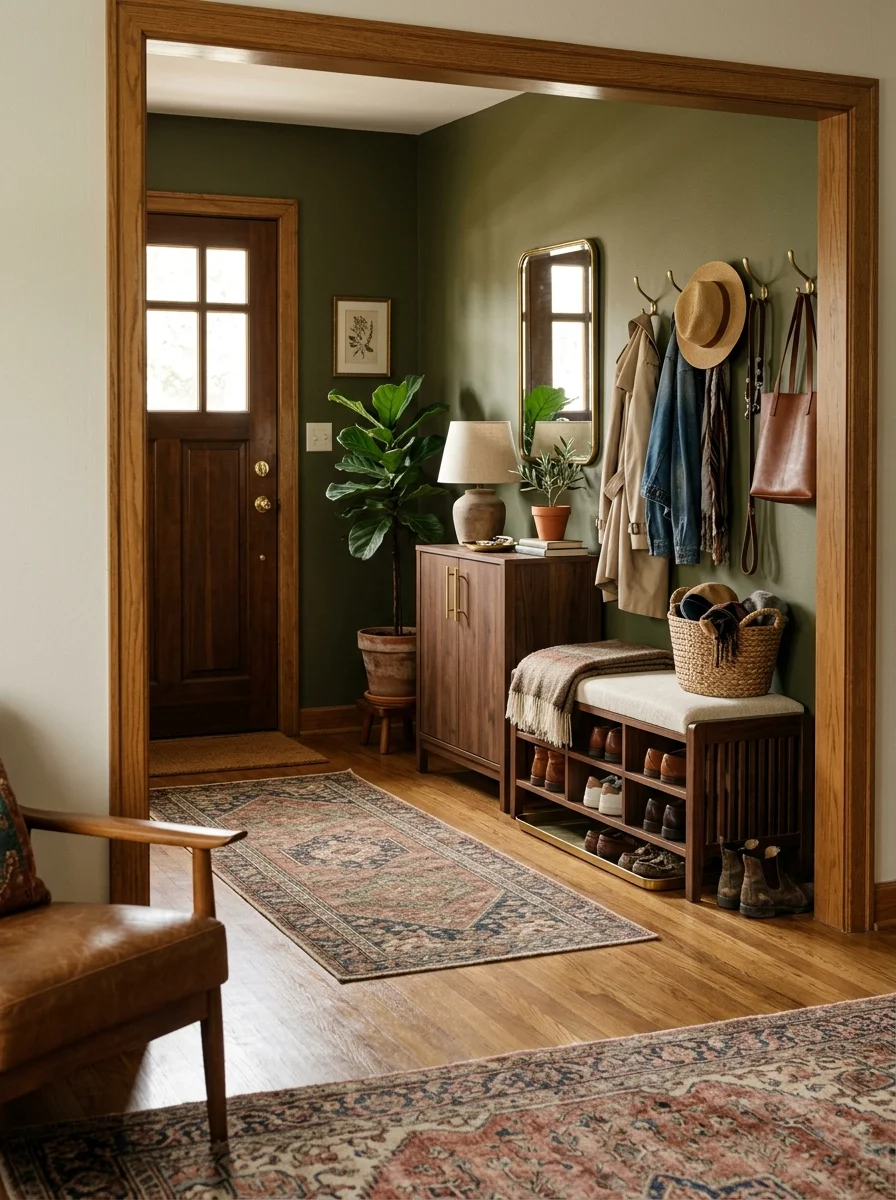
Entryway Shoe Storage Ideas That Actually Work
Discover practical entryway shoe storage ideas for small foyers, apartments, narrow hallways, and busy family homes without making the entrance feel cluttered.
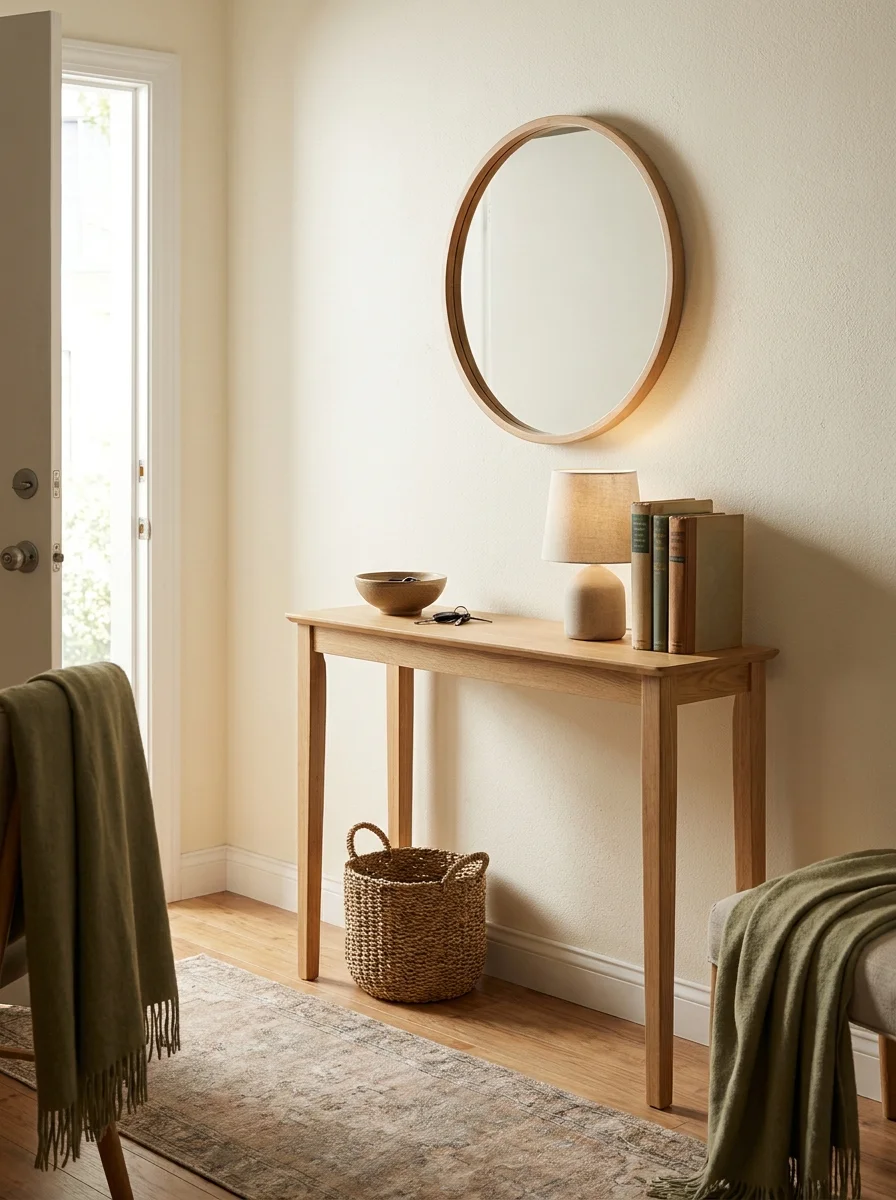
23 Entryway Storage Ideas That Keep Clutter Under Control
Discover practical entryway storage ideas for shoes, coats, bags, keys, and everyday clutter, including smart solutions for small entrances, apartments, and narrow hallways.
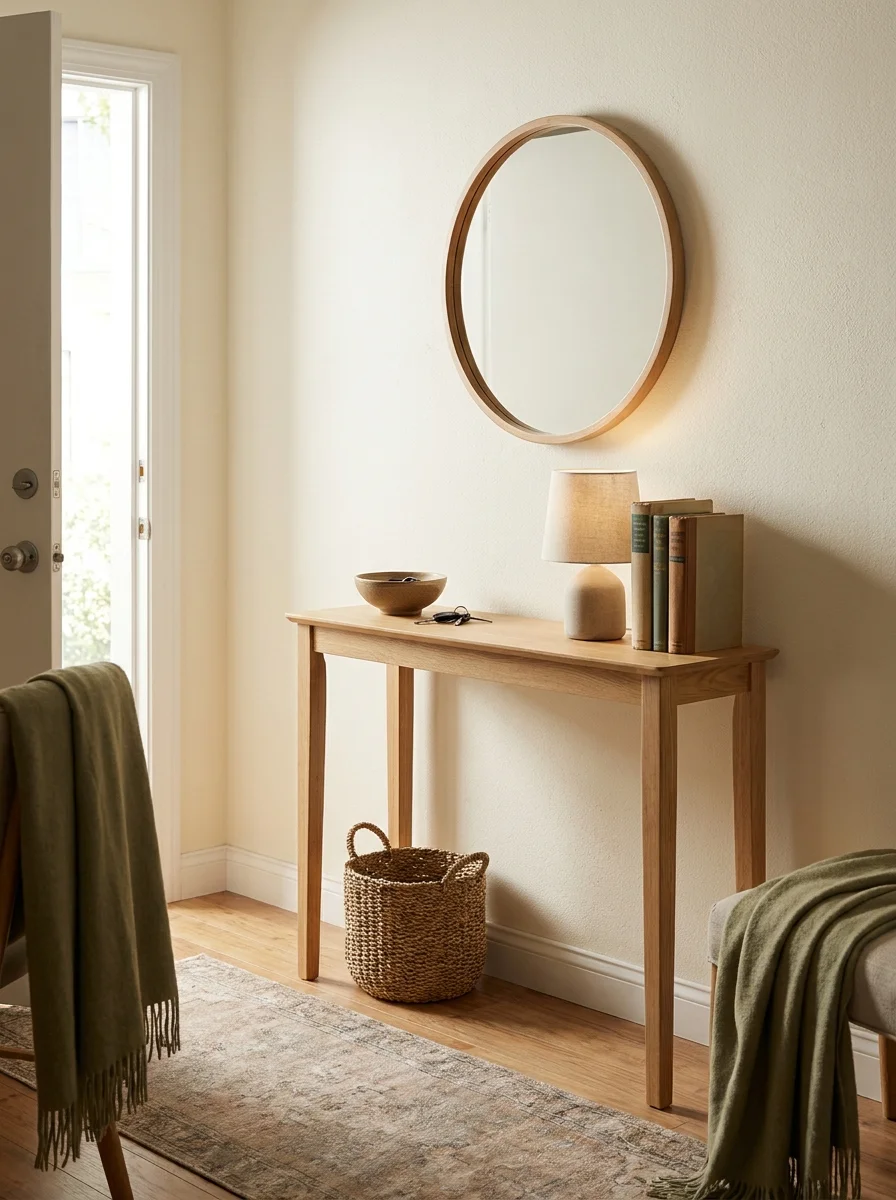
21 Small Entryway Ideas That Make Every Inch Work
Make the most of a small entrance with these practical small entryway ideas for storage, furniture, mirrors, lighting, and stylish everyday organization.
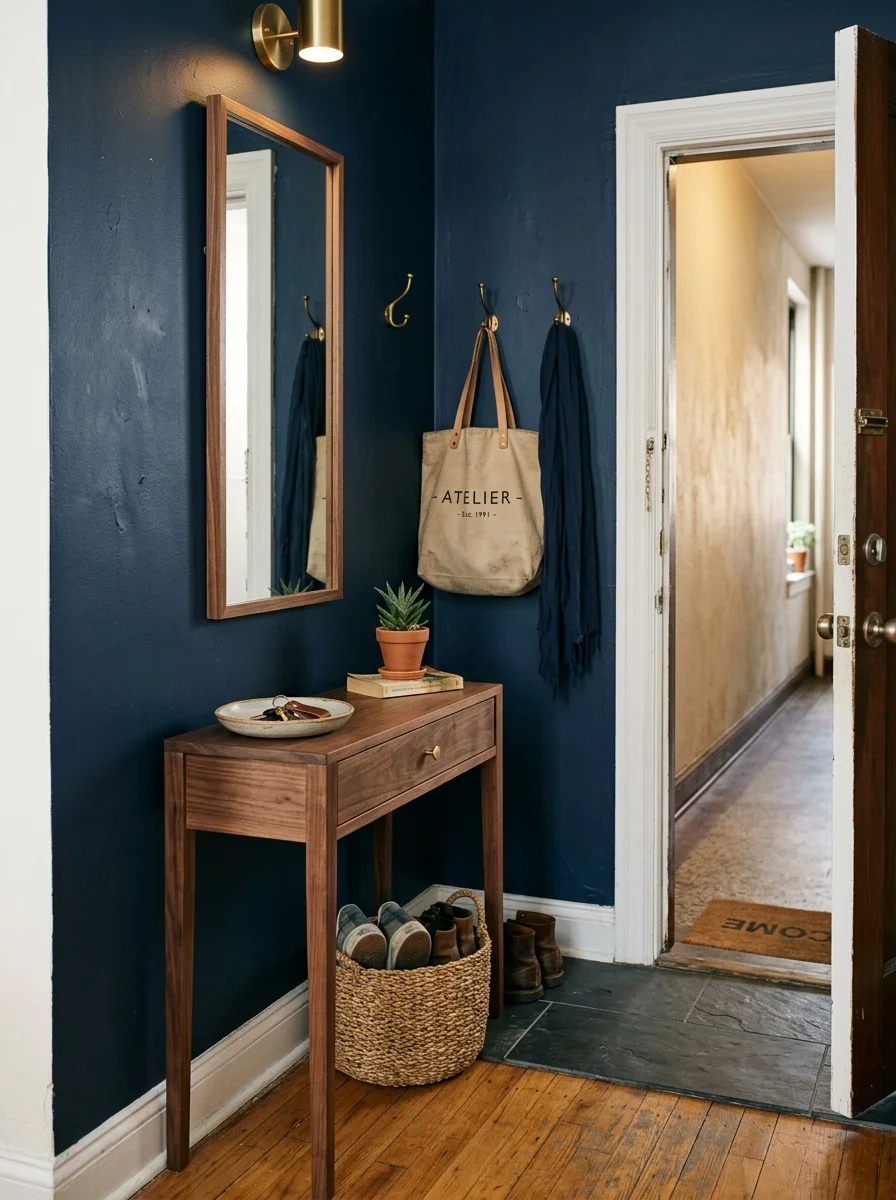
Apartment Organization Ideas for a More Functional Home
Organize your apartment with practical storage ideas for entryways, kitchens, bedrooms, bathrooms, living rooms, closets, and awkward spaces without making your home feel over-organized.