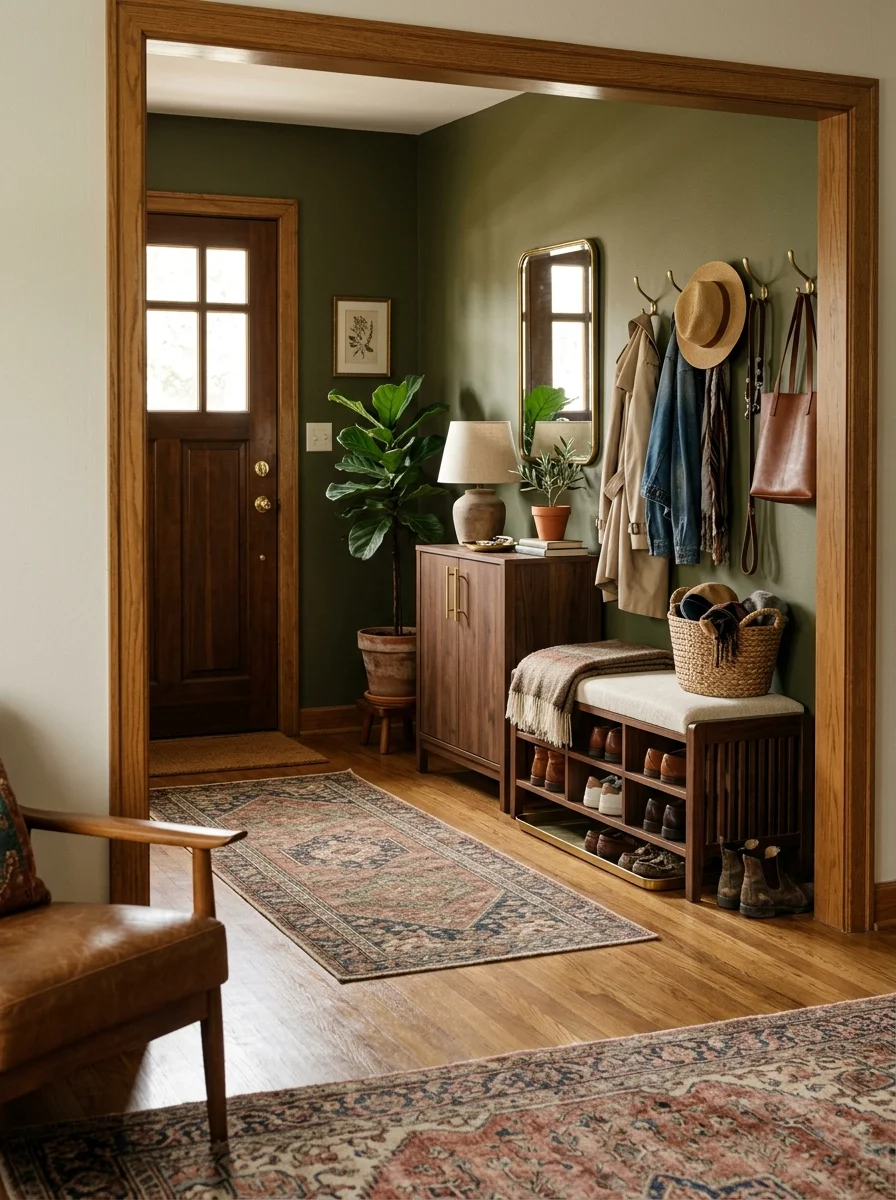
The Problem With Entryway Shoe Storage
Shoes have a way of making an entryway look messy faster than almost anything else.
A single pair left beside the door is harmless. Then another appears. Then everyday sneakers, slippers, boots, sandals, school shoes, and the pair you wore yesterday all start collecting around the same small patch of floor.
The problem is usually not that an entryway has too many shoes. It is that the storage system does not match how the household actually uses the space.
A beautiful shoe cabinet that requires everyone to open three doors before putting shoes away will eventually become decorative furniture with a pile of shoes beside it.
Good entryway shoe storage should make the easiest behavior the correct one.
That might mean an open basket for everyday footwear, a slim cabinet for a narrow hallway, a bench with concealed compartments, or simply a dedicated pair-per-person zone near the door.
The goal is not to hide every shoe. It is to give every regularly used pair a sensible place to land.
Start With the Shoes You Actually Need to Store
Before buying a cabinet, bench, rack, or basket, look at what normally accumulates by your door.
Not every shoe needs to live in the entryway. A useful system usually separates footwear into three distinct groups:
- Everyday shoes: These are the pairs used constantly. They deserve the easiest access.
- Occasional shoes: Dress shoes, special-event footwear, and less frequently worn pairs can live farther away from the entrance.
- Seasonal shoes: Heavy boots, snow shoes, or rarely used summer sandals are better stored in a closet or under-bed container rather than occupying valuable entryway space year-round.
This simple distinction can dramatically reduce the amount of storage furniture you actually need.
1. Give Everyday Shoes an Open Home
For households where shoes come off immediately at the door, completely closed storage can sometimes create unnecessary friction.
An open cubby, low basket, or shallow shelf can work better for the two or three pairs used most often.
The trick is to define the amount of visible storage. Instead of allowing an entire wall to become an open shoe display, create a small designated zone.
A compact three-level shelf beneath a console or beside the door can hold everyday footwear while keeping the rest of the entrance visually quiet.
- Best for: Busy households, children, daily sneakers, and casual slip-ons.
- Design note: Open storage works best when it has a clear capacity limit. Once the shelf is full, additional shoes must return to their secondary home.
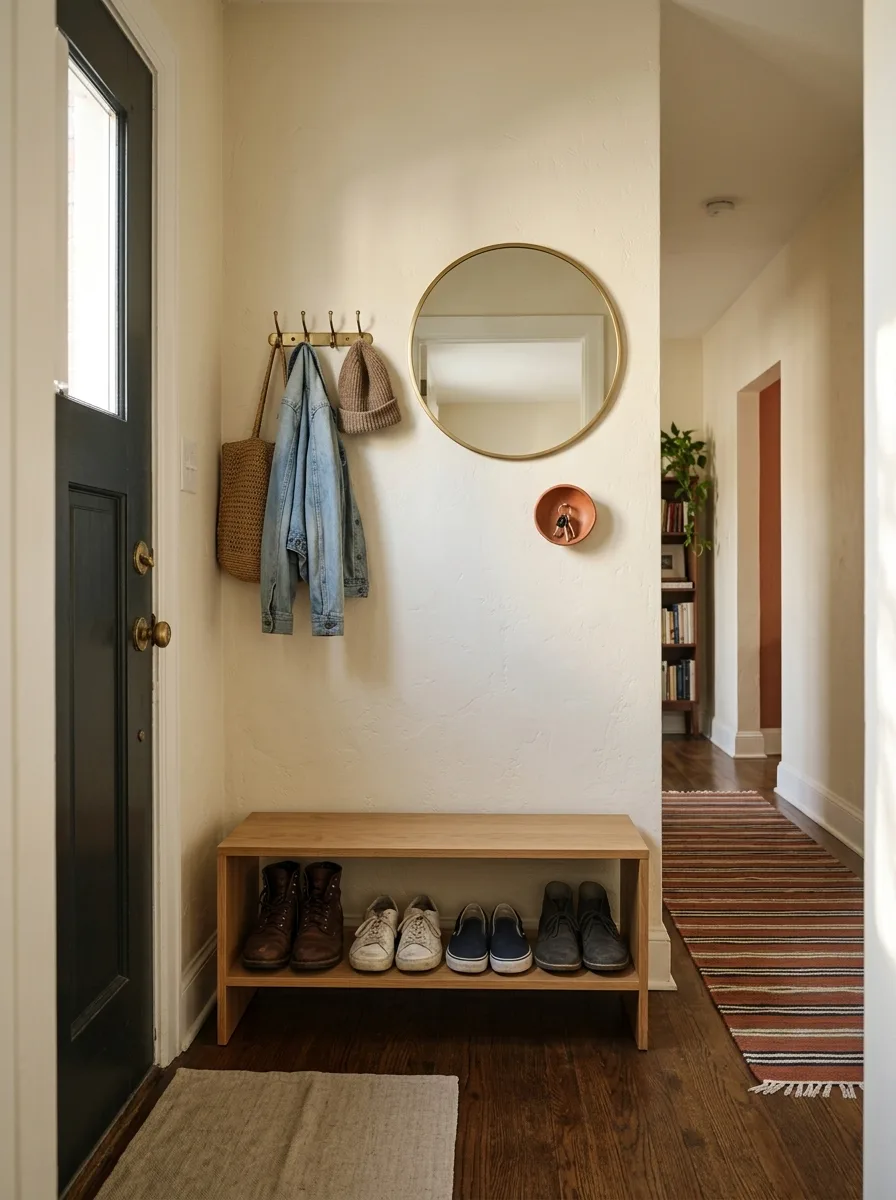
Design Tip: Limit open shoe shelves to no more than 6 to 8 pairs total; anything more begins to read as visual clutter.
2. Use a Closed Cabinet When Visual Calm Matters
If visible shoes make the entryway feel cluttered, a closed shoe cabinet can create a much cleaner, streamlined appearance.
Look for a cabinet that is relatively shallow rather than simply choosing the largest storage unit available.
Flip-down shoe cabinets can be especially useful in narrow entrances because they store footwear vertically while keeping the footprint exceptionally small.
A closed cabinet also gives the entryway a more furniture-like appearance. Choose one that relates visually to the rest of the room rather than treating it as purely utilitarian storage:
- A light wood cabinet can warm up a neutral entrance.
- A painted cabinet can blend seamlessly into the wall color.
- A dark wood or blackened cabinet can create striking contrast beneath a mirror or artwork.
Best for: Visually tidy homes, narrow entrances, apartments, and entrances that open directly into living spaces.
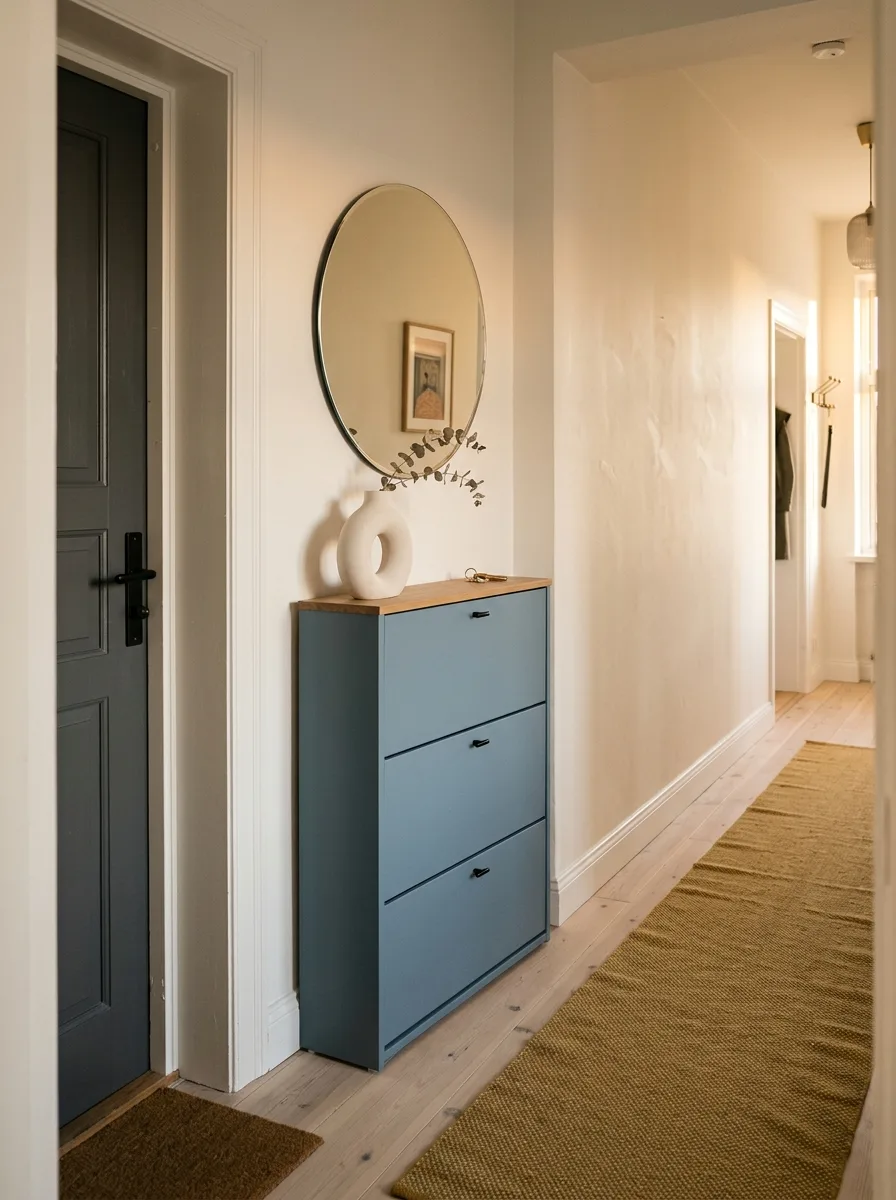
Design Principle: Closed shoe storage creates an instant visual boundary between outdoor street debris and the calm of the home.
3. Let a Bench Do Two Jobs
A bench is one of the most useful pieces of furniture in an entryway because it solves two separate problems: seating and storage.
The most practical versions create storage beneath the seat. That might be:
- Open cubbies
- Pull-out woven baskets
- Concealed drawers
- Lift-up lidded compartments
- Individual shoe shelves
The important detail is height. A bench that is comfortable for sitting down to lace shoes should typically sit between 17 and 19 inches high. It should not become so tall that it feels awkward to sit on.
For a compact entrance, a bench sized to the width of an available wall can become the visual anchor for the entire entryway arrangement. Add a row of hooks above it and the space handles shoes, coats, bags, and daily accessories in one cohesive zone.
Best for: Families, households where people sit to put shoes on, and homes needing multiple functions from a single footprint.
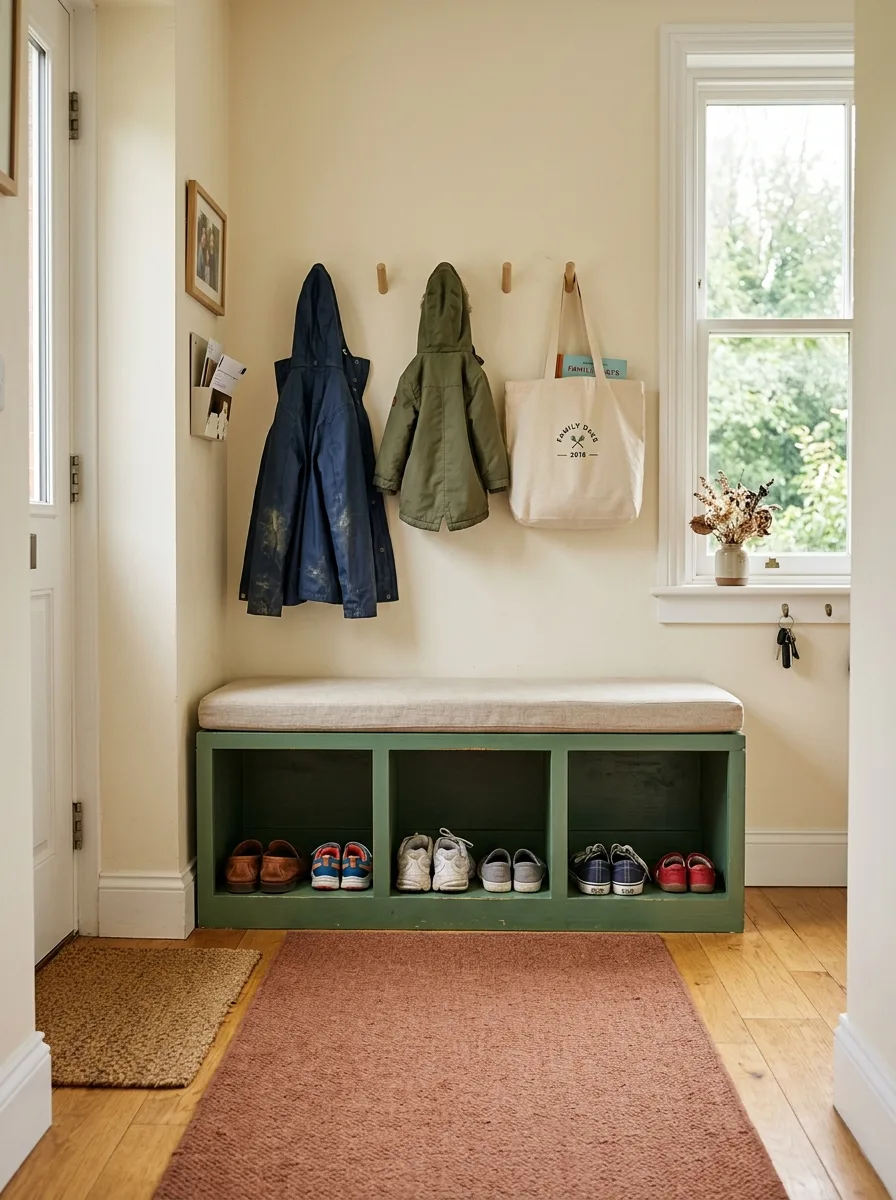
Design Tip: Select a bench with integrated pull-out drawers if you want the seating convenience of a bench with the clean look of closed storage.
4. Build a Shoe Zone Under the Console
Not every entryway needs dedicated shoe furniture.
If you already have a console table, look underneath it. That lower area can often become useful shoe storage without adding another piece of furniture to the floor plan.
A slim basket, low shelf, or pair of matching shoe trays can sit beneath the console while the tabletop remains available for a lamp, mirror, artwork, or small catchall bowl.
This works particularly well when only a few pairs need to remain near the entrance. It also keeps the footwear visually subordinate to the main furniture piece.
The principle: Use space that already exists before introducing another object into the room.
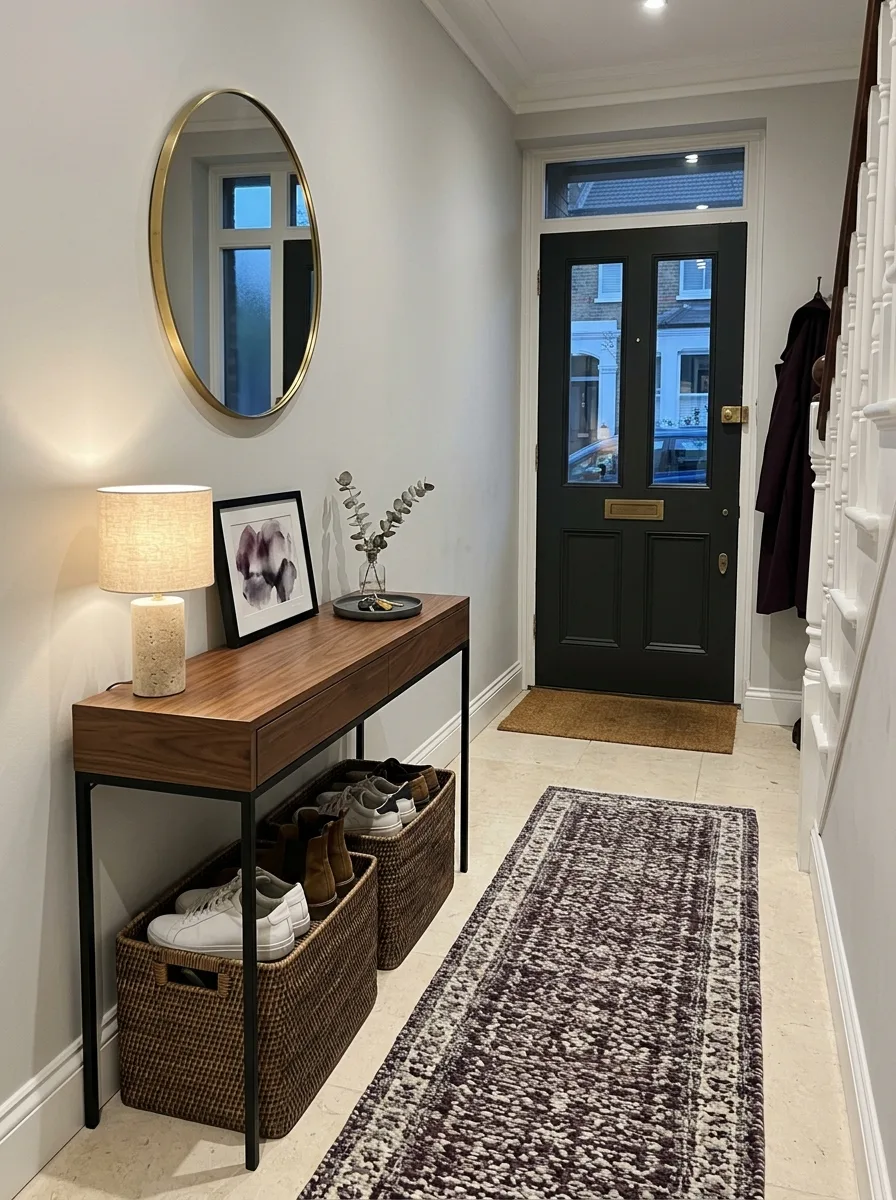
Design Tip: Choose shoe trays in brass, dark rubber, or slate that match the finish of your console legs for an intentional look.
5. Choose Vertical Storage for a Narrow Hallway
Narrow hallways create a specific shoe-storage problem: there may be plenty of vertical wall space but almost no usable floor depth.
This is where vertical storage becomes significantly more useful than wide, low shelving.
A tall, slim shoe cabinet can hold multiple rows of footwear while projecting only 7 to 10 inches into the hallway.
Before installing one, however, check the actual walking path:
- A storage cabinet is not successful if opening its doors blocks the only comfortable route through the hallway.
- For especially tight corridors, consider furniture with flip-down doors that open vertically or shallow pull-down compartments designed specifically for shoes.
Best for: Narrow corridors, long hallways, and entrances where floor depth is strictly limited.
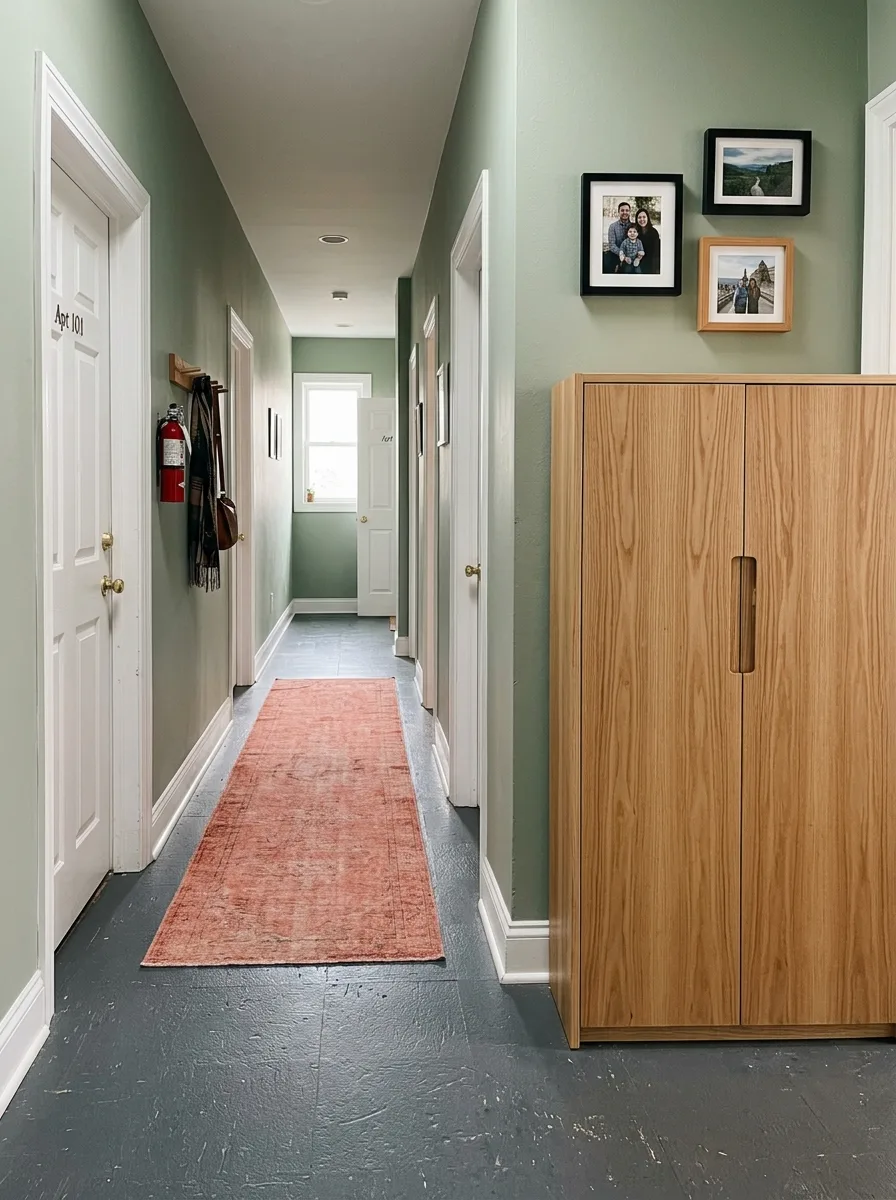
Design Principle: In halls under 40 inches wide, never choose storage deeper than 10 inches; every inch of walking clearance is vital.
6. Give Each Person a Shoe Zone
Shared entryways often become chaotic because everyone uses the same storage area without knowing where their own belongings belong.
A simple solution is to divide the storage:
- One cubby per person
- One dedicated basket per household member
- One shelf section per person
- Labeled pull-out drawers for children
- Separate everyday and occasional footwear zones
The system does not need to look like an institutional mudroom. In a refined home, identical woven baskets or matching drawers create the exact same structure without visual noise.
This approach is especially useful when several people enter and leave the home at different times. The goal is to eliminate the question, “Where should I put these?”
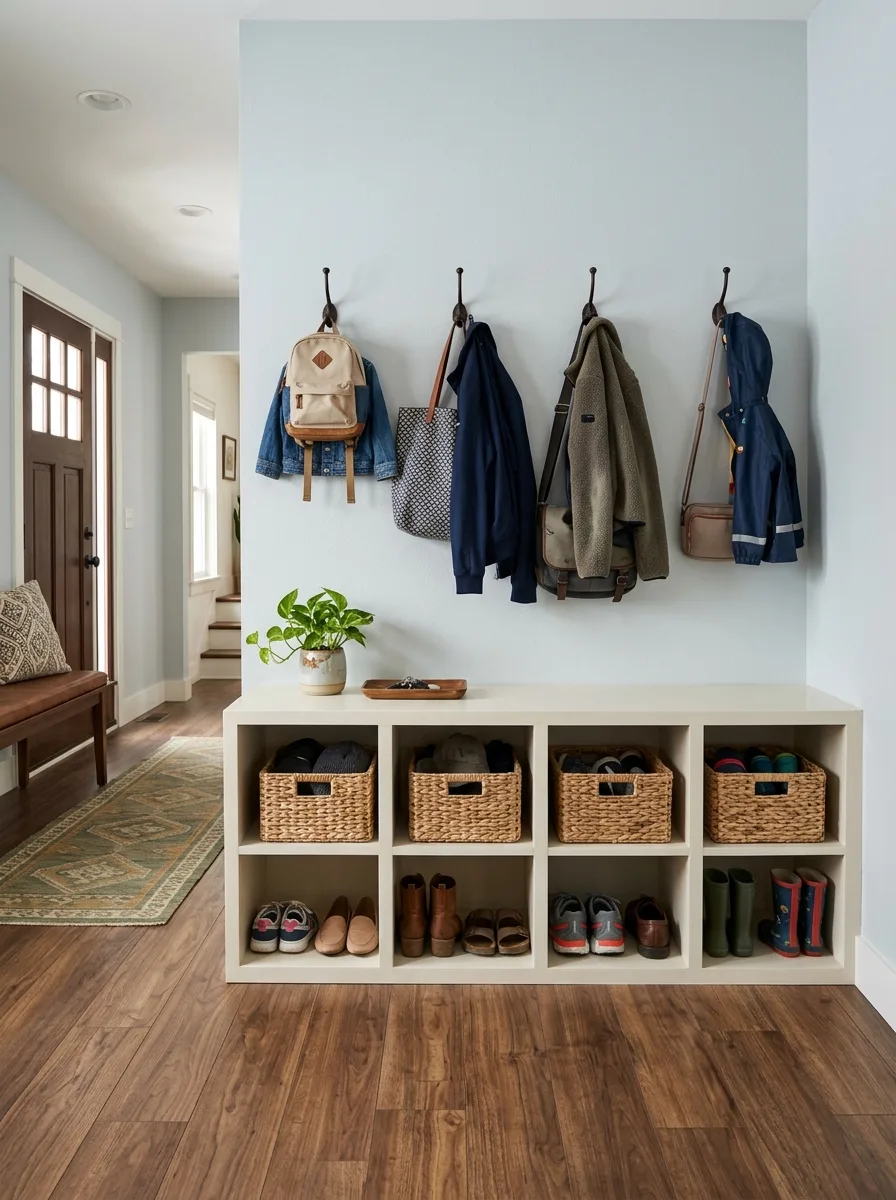
Design Tip: Assign lower compartments to younger family members and higher sections to adults to make putting shoes away effortless for everyone.
7. Use a Slim Shoe Cabinet Beside the Door
Sometimes the best shoe-storage location is not the largest available wall. It is simply the wall closest to where shoes actually come off.
A narrow cabinet positioned directly beside the entrance can capture footwear before it spreads into the hallway or living area.
This is particularly effective in apartments where the front door opens directly into a living room or kitchen without a formal foyer.
Keep the cabinet visually quiet. A small mirror, framed art print, or small task lamp above it makes the storage feel intentional rather than like an added utility box.
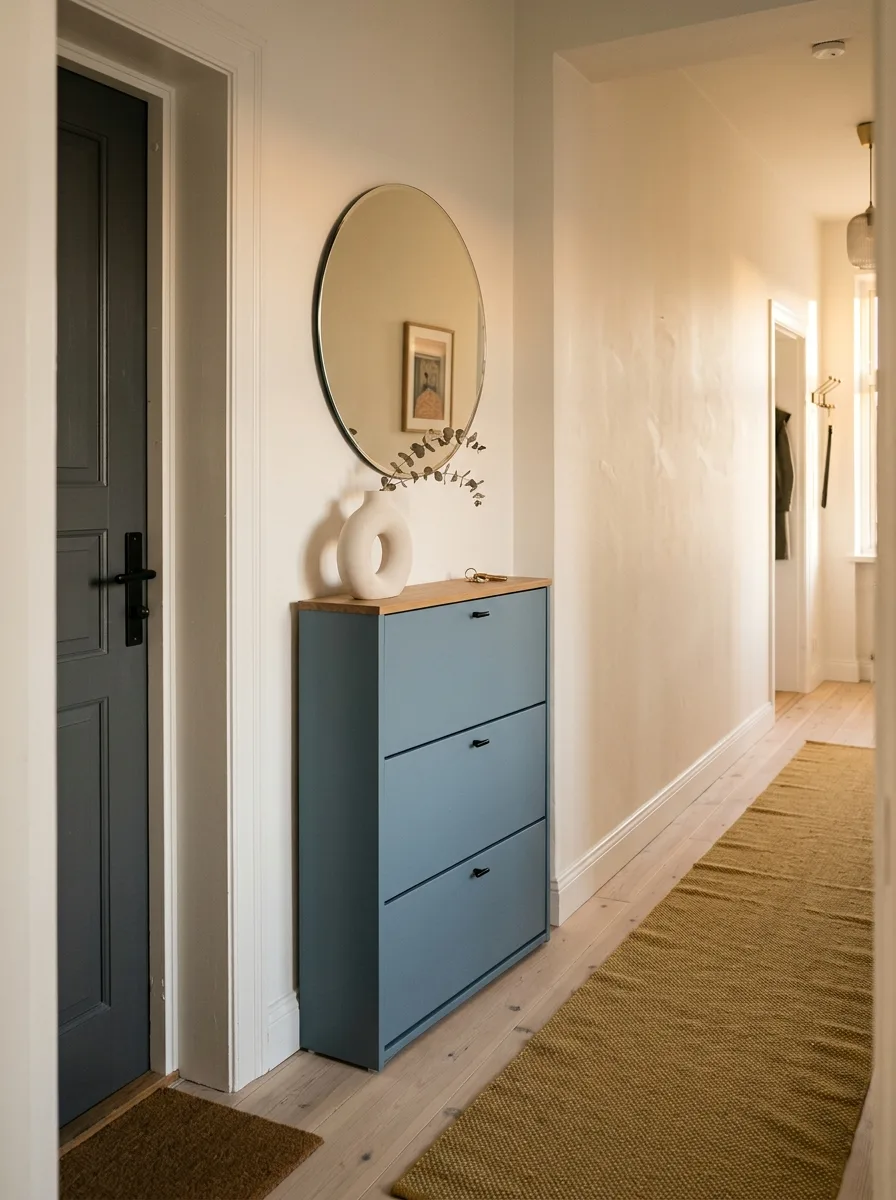
Design Tip: A shallow flip-down cabinet placed behind an open door swing can capture unused dead wall space.
8. Put Boots Where They Can Dry
Shoes are not all equal. Boots and wet footwear need different treatment from clean, dry everyday sneakers.
If the entrance regularly receives wet shoes or muddy boots, create a small, hard-wearing landing area:
- A washable boot tray beneath a bench or inside a low shoe zone protects wood flooring and rugs from water and grit.
- Leave enough vertical clearance for taller footwear rather than forcing boots into compartments designed for low-top shoes.
- In colder or wetter climates, ventilation also matters: a completely enclosed airtight cabinet is less suitable for damp footwear immediately after use.
A useful rule: Wet shoes need somewhere to dry before they need somewhere to hide.
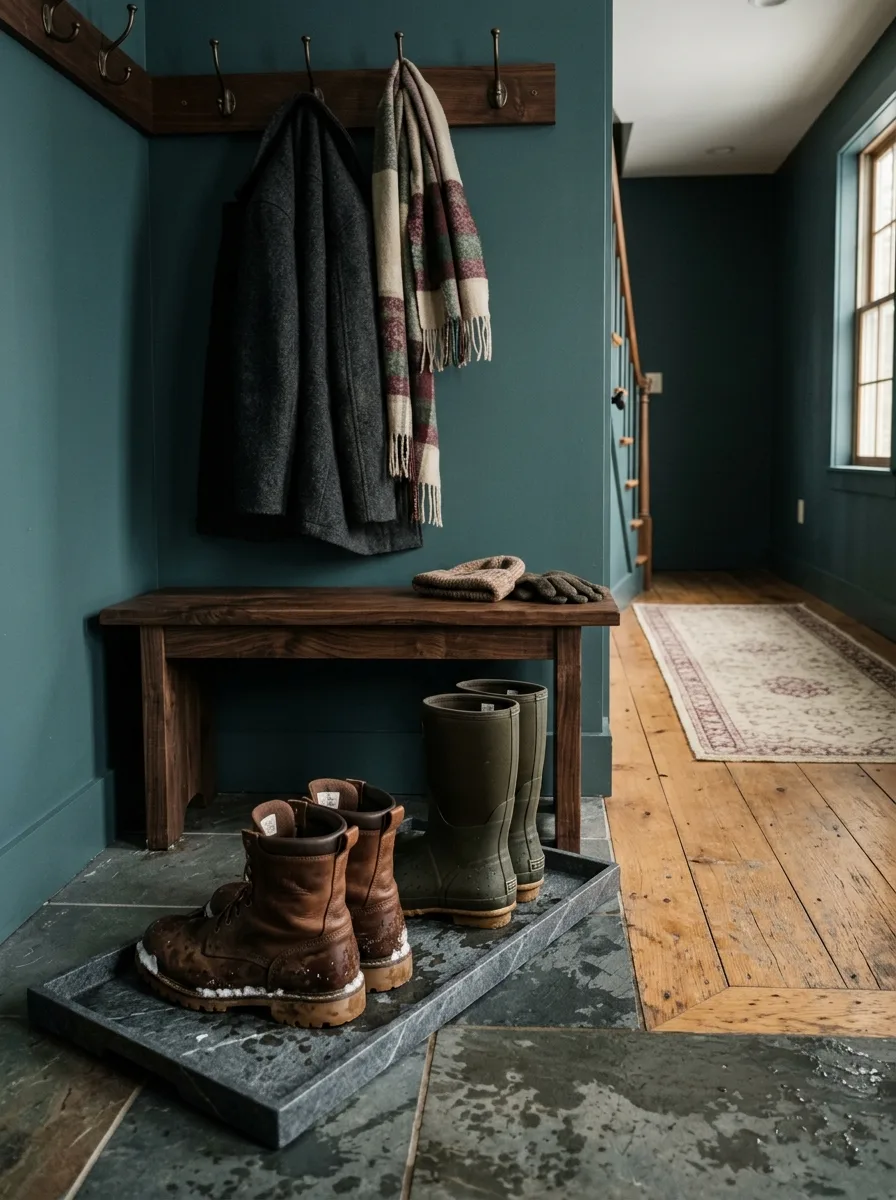
Design Tip: Fill a shallow zinc or rubber boot tray with river stones—it allows melted snow and water to drain below the soles so boots dry faster.
9. Create a “Today” Shoe Shelf
One of the simplest ways to prevent shoe piles is to separate currently used footwear from the rest of your collection.
A small shelf can be designated as the “today” zone. Only the shoes currently in active rotation live there. Everything else returns to a closet, cabinet, bedroom wardrobe, or seasonal storage area.
This works because it acknowledges human reality: most people do not put away every single pair after every use. A designated temporary landing place is far more realistic than expecting perfection.
The shelf should be intentionally small. Its limited size is an active part of the system—once it fills up, a pair must be returned to secondary storage.
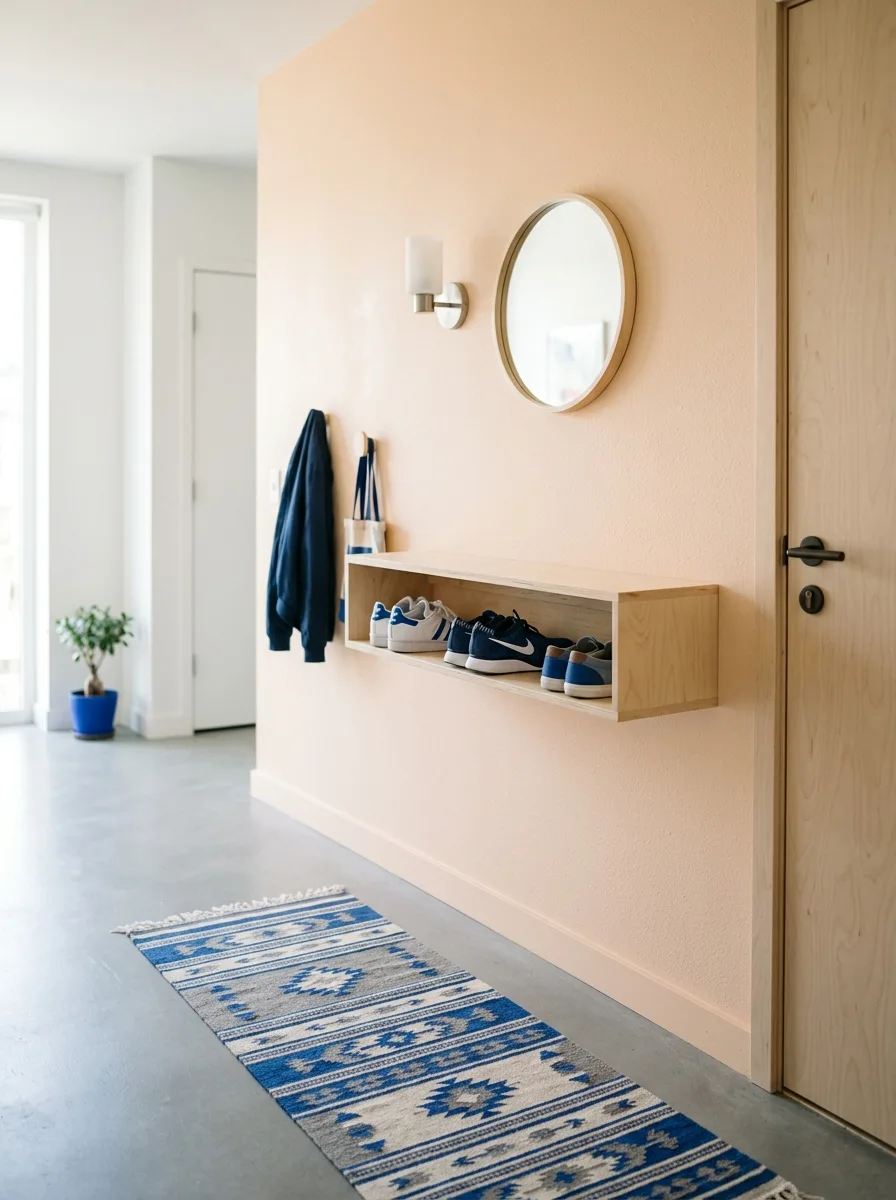
Design Principle: Restricting temporary landing zones to two pairs per person prevents temporary convenience from turning into permanent floor clutter.
10. Use Baskets When You Want Softer Storage
Baskets can make an entryway shoe area feel warm and organic rather than utilitarian.
They are especially effective beneath benches, consoles, and open lower shelves. A pair of large woven baskets can accommodate casual footwear while adding rich texture to a space that might otherwise contain mostly hard painted surfaces and wood.
However, baskets are better for flexible storage than precise, rigid organization:
- If you need to see every pair of shoes immediately, open shelves are easier.
- If your priority is making everyday clutter visually softer and forgiving, baskets are unbeatable.
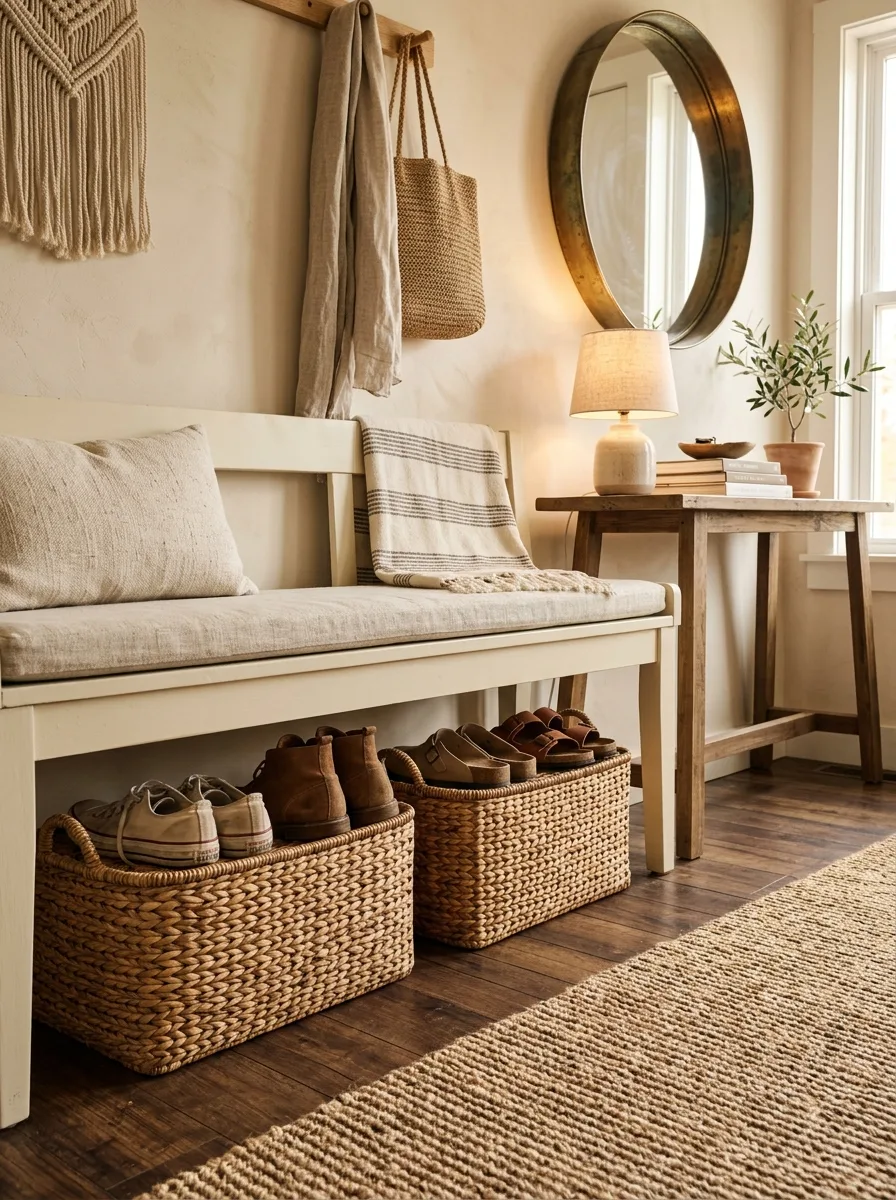
Design Tip: Select rectangular baskets with sturdy handles that slide out like drawers without scratching your flooring.
11. Turn the Bottom of a Closet Into Shoe Storage
If your entryway already features a built-in coat closet, you may not need another freestanding piece of furniture.
Look at the bottom section:
- A single raised shelf separates shoes from coats hanging above.
- A two-tier shoe rack creates a high-capacity footwear zone.
- A shallow tray can contain the pairs used most frequently while keeping dust and dirt off closet flooring.
This approach has one major advantage: the storage is already located where clutter begins.
Instead of carrying shoes through the home to another room, shoes are contained behind closed doors right at the threshold. If the closet is deep, avoid pushing everyday shoes all the way to the back—keep active footwear right in front.
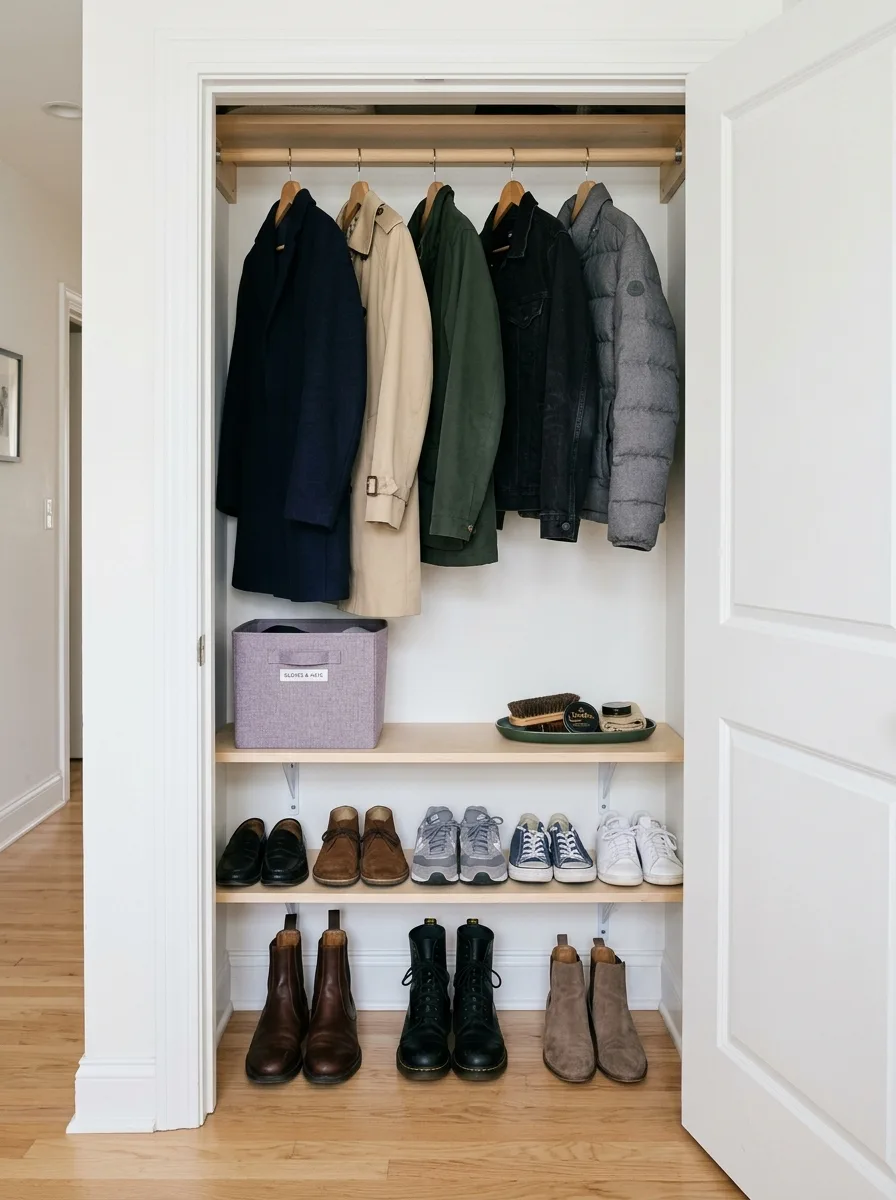
Design Tip: Install battery-powered motion-sensor LED strip lights beneath the lowest hanging rod to illuminate shoe shelves automatically.
12. Use a Shoe Bench in a Small Apartment
Apartments often require furniture to perform several functions simultaneously.
A shoe bench is particularly useful because it combines: $$\text{Seating} + \text{Shoe Storage} + \text{Visual Structure}$$
Choose a compact version that does not overwhelm the modest entrance. A simple upholstered bench with a lower slatted shelf is often plenty.
For a very small foyer, the bench can also become the home for a small basket containing slippers, shoe-care supplies, or reusable grocery bags. The result is a highly functional landing zone without turning the entrance into a dedicated storage facility.
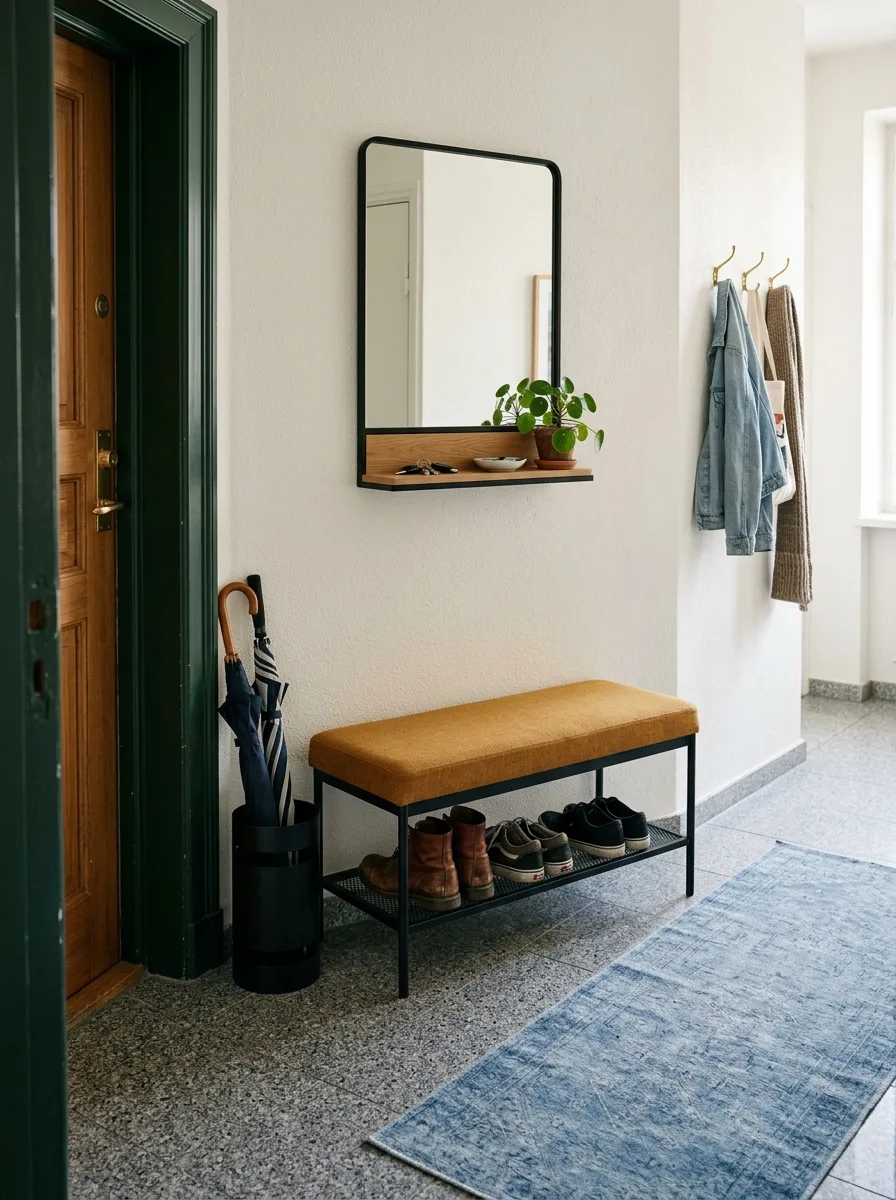
Design Tip: In tight studio apartments, an open-slatted lower shelf keeps visual weight light while allowing air circulation.
13. Keep Frequently Used Shoes at Hand Height
There is a natural tendency to place shoes wherever there happens to be spare room in a cabinet. But storage height directly influences how easy the system is to maintain.
Everyday shoes should generally be the easiest to reach. Less-used shoes can occupy higher shelves or deeper compartments, while seasonal footwear can move even farther away.
This establishes a clear spatial hierarchy: $$\text{Easy Access (Waist / Eye Height)} \longrightarrow \text{Moderate Access} \longrightarrow \text{Long-Term Storage}$$
Instead of treating every pair equally, let frequency determine location. That small adjustment can make an existing shoe cabinet feel twice as functional.
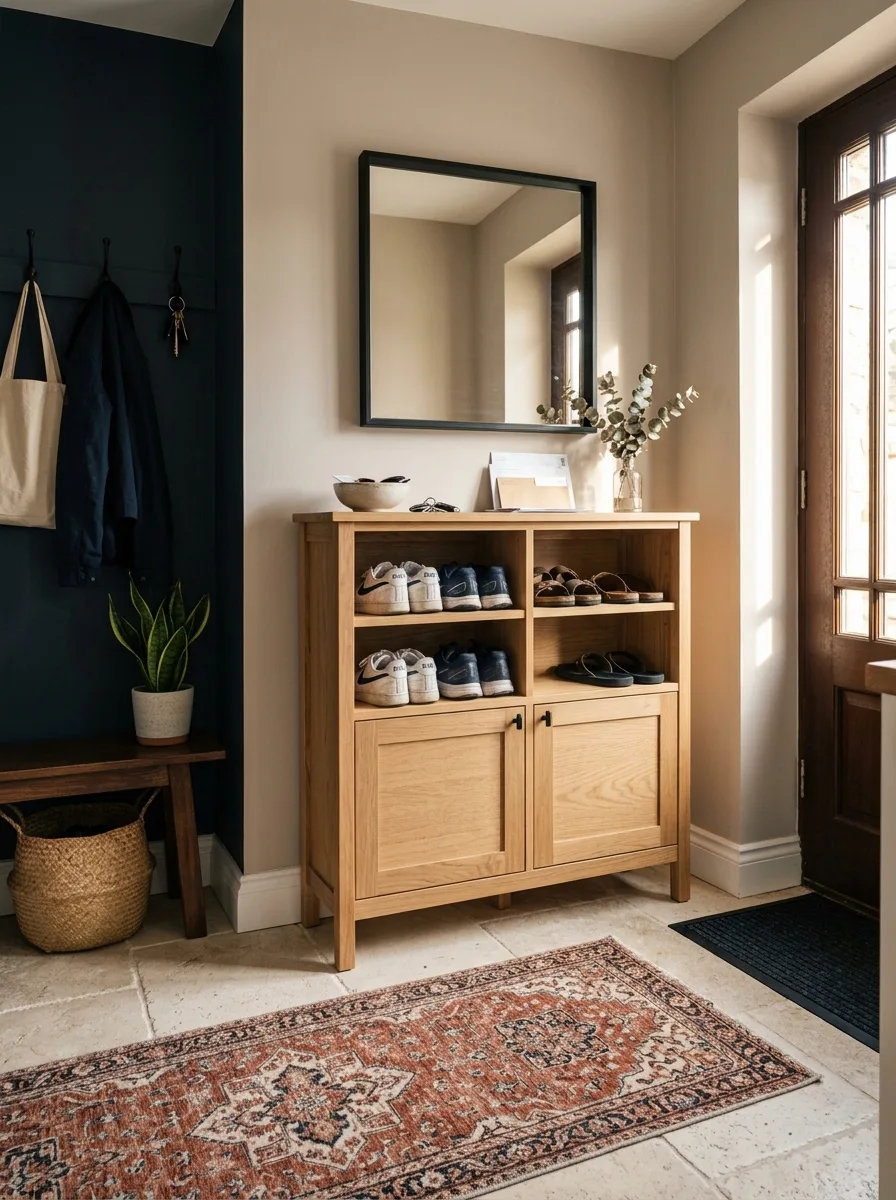
Design Principle: Ergonomics dictates habits. Store what you wear daily at the height of least resistance.
14. Make Shoe Storage Part of the Entryway Design
Functional shoe storage does not have to look purely utilitarian. A shoe cabinet can become the centerpiece of the entryway’s visual composition.
Pair the cabinet with intentional decor:
- A large wall mirror to bounce natural light
- A framed art print or photograph
- A small warm ceramic table lamp
- A decorative marble or brass catchall bowl
- A wall sconce for evening ambiance
- A durable, patterned runner
- A hardy potted plant suited to available light levels
The key is not to decorate excessively. One or two deliberate accents make the entire entrance feel considered and hospitable, which is especially vital in open-plan layouts where the front door is visible from the sofa.
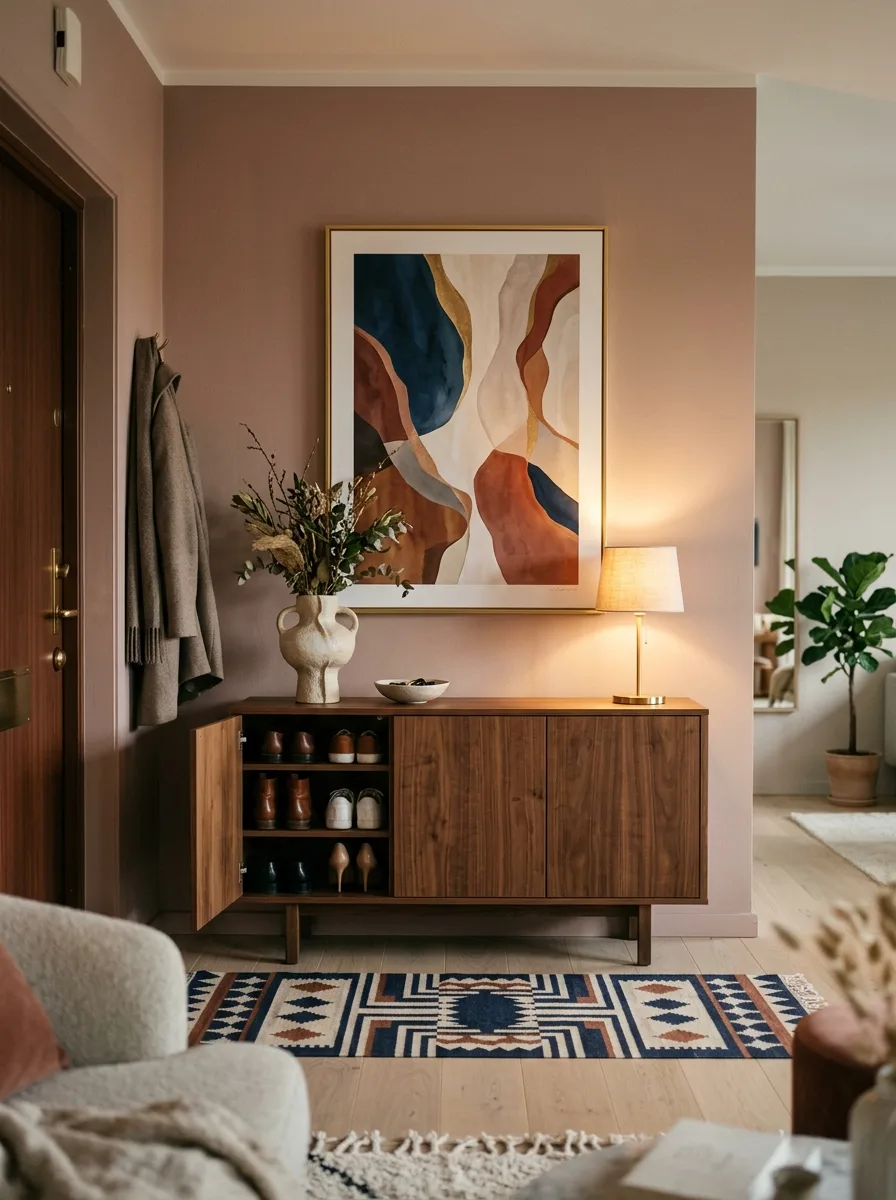
Design Tip: Hang a large mirror directly above your shoe cabinet—it balances the visual weight of the storage while making the foyer feel twice as bright.
15. Use a Narrow Rack When You Need Maximum Visibility
Open shoe racks are useful when speed and convenience matter more than visual concealment.
They allow you to see every pair immediately and make putting shoes away completely frictionless. But open racks need strict boundaries:
- A rack that stretches endlessly across a wall can quickly look cluttered.
- Choose a compact width (24 to 32 inches) and cap the number of pairs it holds.
- If your household needs more capacity, move rarely used footwear elsewhere rather than continuously expanding the open rack.
Best for: Mudrooms, secondary back entries, closets, and busy households where closed storage is regularly ignored.
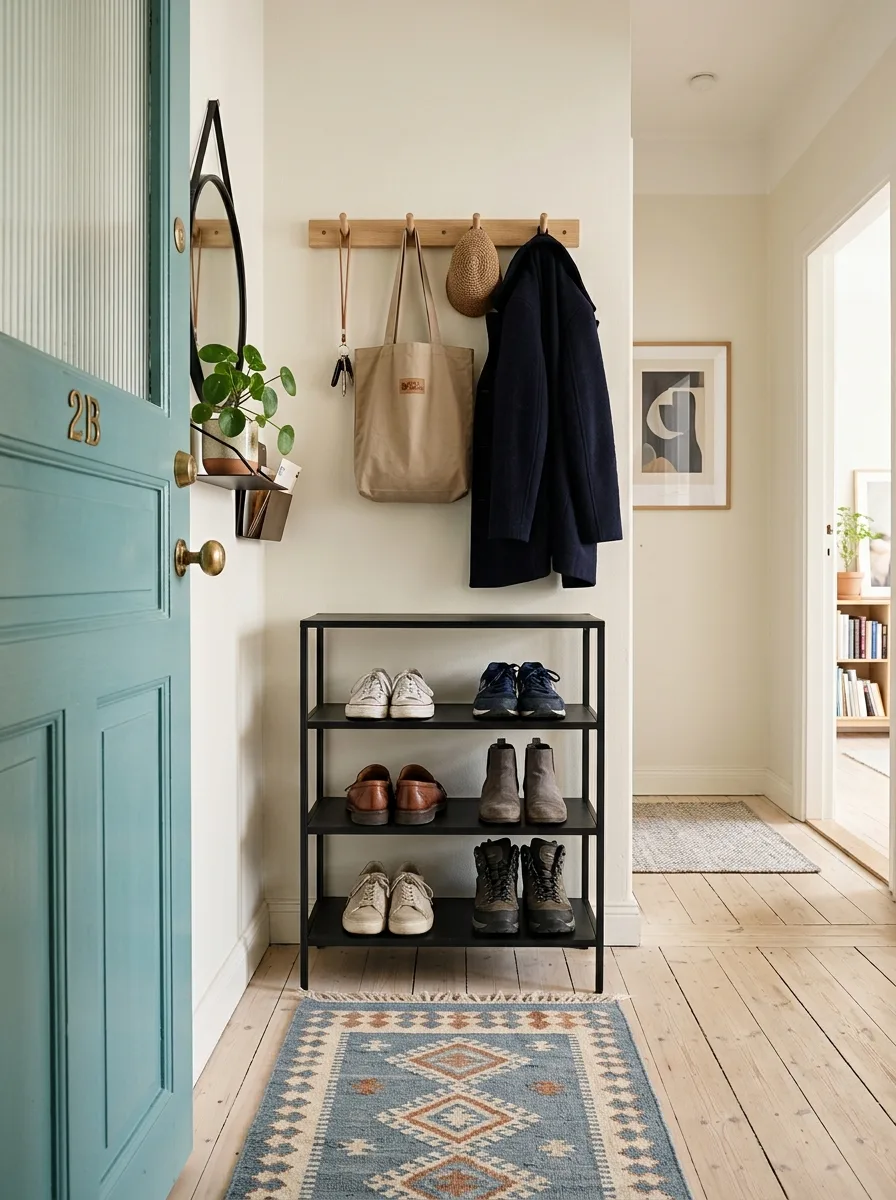
Design Tip: Matte black or warm brass metal racks feel cleaner and more architectural than wire or plastic alternatives.
16. Create a Dedicated Shoe-Care Drawer
Shoe storage becomes far more effective when the accessories associated with footwear live in the exact same spot.
A small shallow drawer or dedicated lidded box can hold:
- Horsehair shoe brushes
- Microfiber buffing cloths
- Neutral leather cream and polish
- Spare laces
- A shoehorn
- Waterproofing spray
- Small heel cushions and insoles
This prevents shoe-care supplies from scattering across bathroom cabinets, bedroom drawers, or utility cupboards. It turns the entryway into a complete footwear station rather than just an accumulation zone.
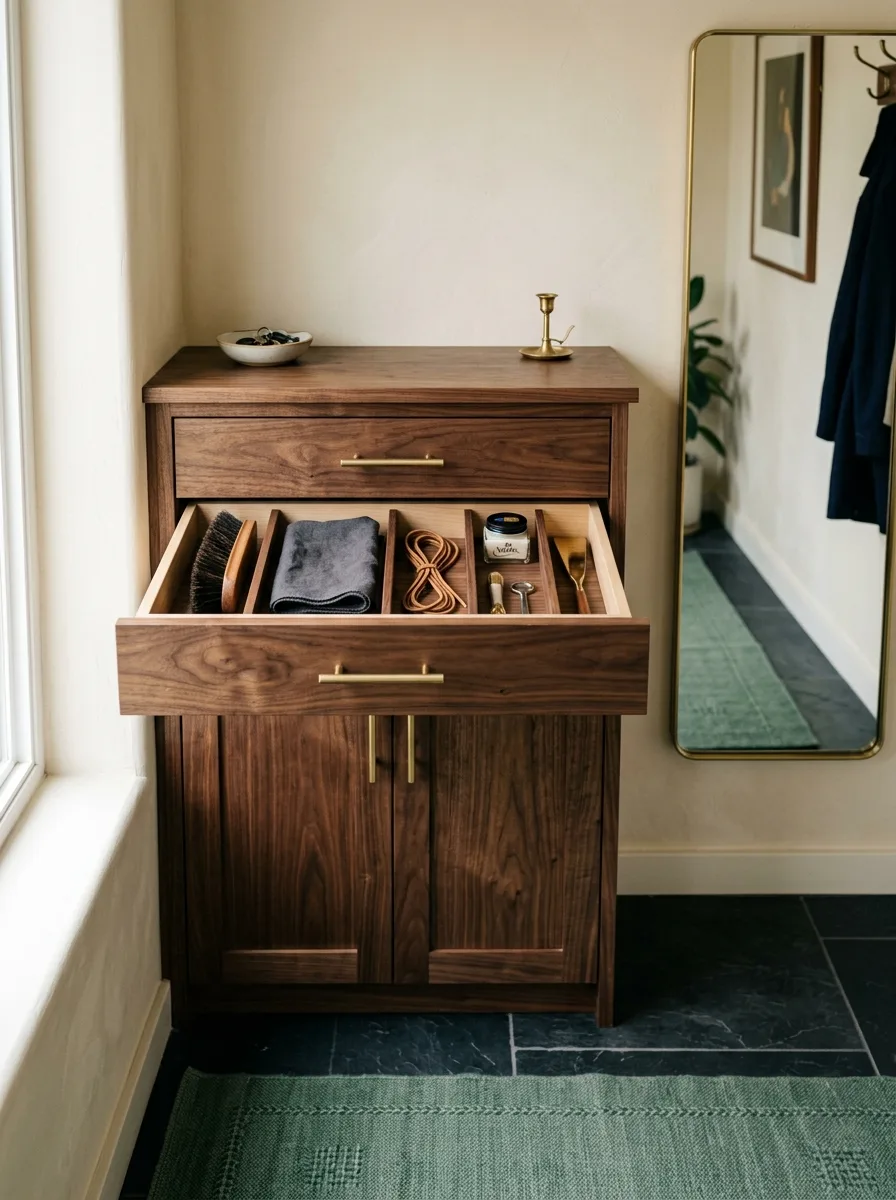
Design Tip: Keep an elegant brass shoehorn hanging right beside the shoe cabinet so putting on dress shoes is effortless.
17. Use a Different System for Children
Children’s shoes present a distinct organizational challenge because accessibility and simplicity matter far more than flawless concealment.
Low open cubbies, labeled cloth bins, or wide shallow baskets are vastly easier for children to navigate than tall cabinets with latching doors:
- Give each child a clearly defined, personal storage space.
- The storage should be low enough to reach without assistance and roomy enough for the footwear they actually use.
- If shoes repeatedly end up scattered on the rug, the problem is rarely discipline—the storage system is simply too cumbersome.
Good organization reduces the number of physical steps required to complete the task.
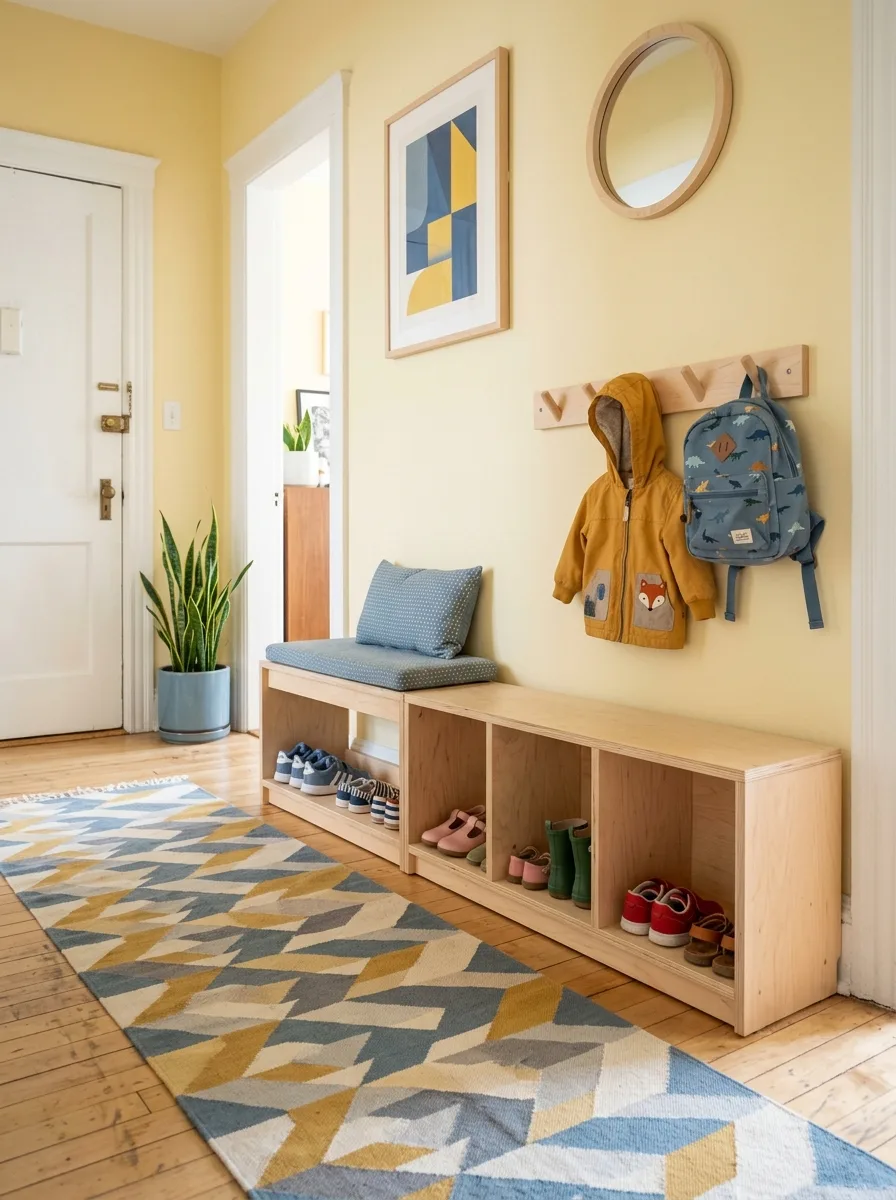
Design Principle: If a child cannot reach and open their storage container with one hand, shoes will end up on the floor 100% of the time.
18. Keep the Floor Mostly Clear
The final shoe-storage principle is less about buying furniture and more about spatial restraint.
An entryway does not need to hold every pair of shoes you own. A visually calm entrance usually has a completely clear walking pathway, with storage concentrated strictly around the room’s perimeter.
Think of the floor as an essential element of the design:
- Leave sufficient clearance for people to enter, close the door, remove shoes, turn around, and set down grocery bags without navigating an obstacle course.
- Even a modest storage unit looks elevated and intentional when the floor around it remains open and clean.
The best shoe-storage system is not the one that holds the most shoes. It is the one that keeps everyday life moving without friction.
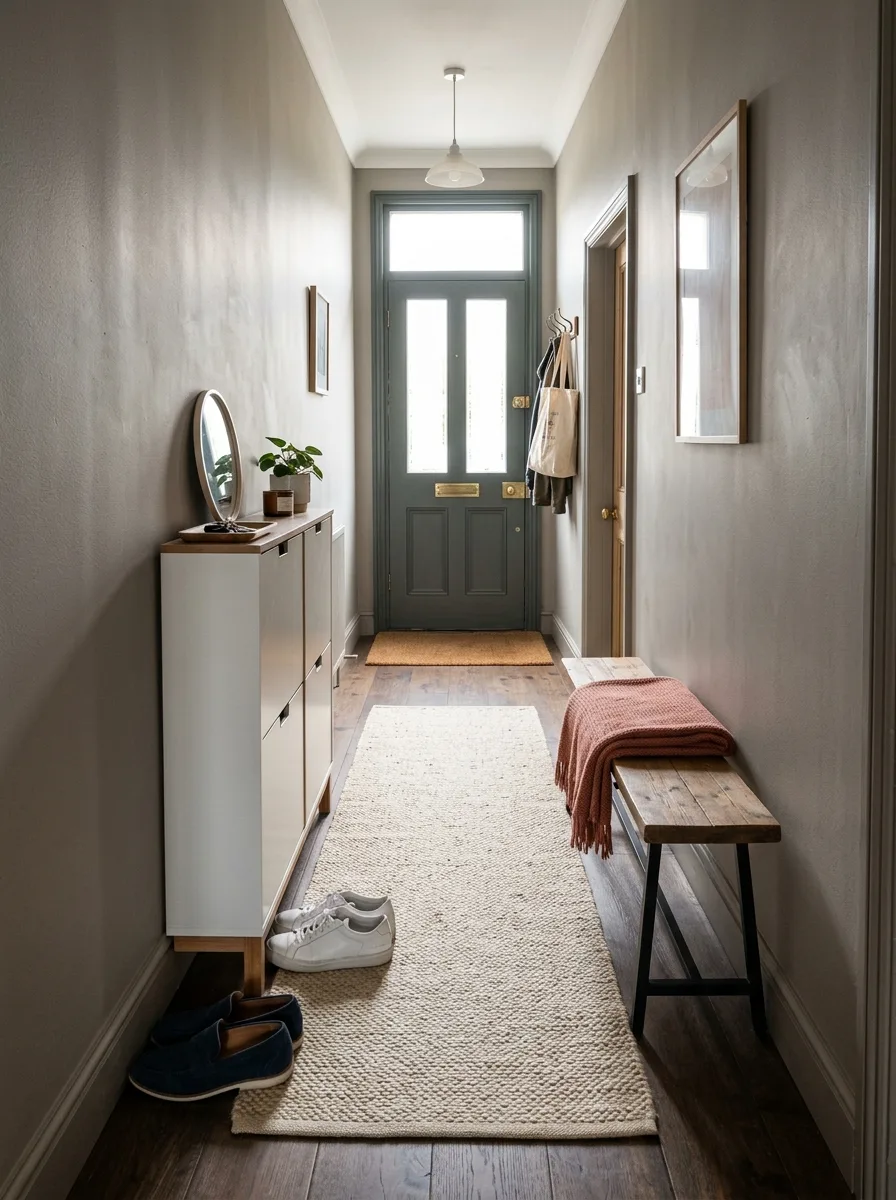
Design Tip: Keep at least 36 inches of unobstructed floor space in front of your entrance door for natural entry and exit flow.
How to Choose the Right Entryway Shoe Storage
Instead of starting with a furniture catalog, start with your home’s specific architectural problem:
| Your Entryway Problem | Storage Approach to Consider |
|---|---|
| Only a few everyday pairs | Small open shelf, shoe tray, or low basket |
| Shoes are visually distracting | Closed flip-down shoe cabinet |
| You need somewhere to sit down | Storage bench with cubbies or drawers |
| The hallway is very narrow | Ultra-slim vertical shoe cabinet (under 10” deep) |
| Several people share the entrance | Individual labeled cubbies, shelves, or baskets |
| Children use the entrance daily | Low open bins within easy arm’s reach |
| Wet footwear is common | Washable boot tray with river stones + ventilation |
| You already have a console table | Low baskets or shoe trays beneath the lower shelf |
| You have an entry coat closet | Add custom tiered shelving inside the bottom section |
| You rent and cannot drill walls | Freestanding flip cabinet, bench, or matching baskets |
| Shoes are constantly moved around | Create a dedicated “today” zone with strict capacity |
| You have too many seasonal shoes | Move off-season footwear to under-bed storage or wardrobes |
The right solution is often much more compact than you think.
How Much Shoe Storage Do You Actually Need?
A useful starting exercise is counting the pairs that genuinely need to live right by the front door.
Do not count every shoe in your collection. If four people live in a household but only two pairs per person are worn during a normal week, the entryway only needs to accommodate roughly eight everyday pairs.
Everything else can live in secondary storage: bedroom wardrobes, hallway closets, or under-bed bins.
This distinction prevents the foyer from turning into a permanent warehouse. It also allows you to select furniture that complements the scale of the room rather than overwhelming it.
Small Entryway Shoe Storage: What to Prioritize
In a compact foyer or apartment vestibule, prioritize:
- Access: How quickly can shoes be dropped and retrieved?
- Depth: Does the unit protrude into the natural walking lane?
- Visual Weight: Does the furniture look heavy or airy?
A shallow closed cabinet is almost always more functional in tight quarters than a sprawling open rack. A dual-purpose storage bench eliminates the need for separate seating. And if the foyer is truly microscopic, remember that shoe storage doesn’t have to sit directly beside the front door—a nearby alcove or closet just down the hall often works much better.
Common Entryway Shoe Storage Mistakes
- Choosing storage based only on capacity: The biggest cabinet is rarely the best choice; depth, access, and placement matter just as much.
- Keeping every pair by the door: The entrance should support daily routines, not store your entire footwear history.
- Ignoring wet shoes: Damp footwear requires natural ventilation and water-resistant trays to prevent floor damage.
- Using deep furniture in narrow hallways: Deep furniture chokes circulation; measure the walking corridor, not just the blank wall.
- Making storage difficult to reach: If putting shoes away requires unlatching multiple doors or moving bins, shoes will stay on the floor.
- Letting open storage expand indefinitely: Open racks must have strict limits; overflowing shelves look chaotic immediately.
- Forgetting about seating: If people routinely sit to tie laces, a bench solves more practical issues than a tall cabinet.
- Buying storage before editing the collection: Donate worn-out pairs and relocate seasonal shoes before shopping for furniture.
A Simple Entryway Shoe Routine
A functional shoe system stays organized only when the daily routine requires zero extra effort:
- Remove shoes at the entrance: Wet or muddy pairs go directly onto the boot tray.
- Keep only current footwear accessible: Everyday sneakers and flats remain on the primary shelf or in the top cabinet compartment.
- Return occasional shoes to secondary storage: Do not allow dress heels or hiking boots to become permanent entryway fixtures.
- Reset the floor: Ensure the primary walking path remains unobstructed before going to bed.
- Empty the “today” zone regularly: Its strict limited capacity keeps temporary convenience from snowballing into clutter.
Final Thought
Good entryway shoe storage is less about finding a clever novelty product and more about understanding the natural rhythms of the home.
The shoes people wear every day should be effortless to reach. The shoes they rarely wear should not consume prime threshold space. Wet footwear needs an open place to dry. Children need storage they can access without assistance. Narrow hallways demand shallow footprints. And small apartments benefit most from pieces that perform double duty.
When storage aligns with the way you enter, sit, unlace, and move, the entrance naturally remains calm, welcoming, and beautifully uncluttered.
Editorial Guidelines: Quick Practical Rules
- Separate shoes by frequency: Keep daily shoes within immediate reach by the door, and move occasional or seasonal footwear to closets or bedroom storage.
- Set a clear capacity limit: When an open shoe rack or basket is full, extra pairs must be relocated rather than piled on top.
- Account for moisture: Provide a washable tray or ventilated mat for wet boots and rainy-day sneakers before tucking them away.
- Choose shallow cabinets in tight halls: Slim flip-down shoe cabinets project only 7 to 10 inches from the wall, protecting walking pathways.
- Combine seating and storage: A sturdy storage bench with cubbies or pull-out baskets gives family members a comfortable place to sit while putting shoes on.
What Often Goes Wrong (And How to Fix It)
- Storing your entire footwear collection in the entryway: The entrance is a transitional launchpad, not a warehouse.
- Ignoring wet or muddy shoes: Putting damp shoes straight into closed wooden cabinets can cause mildew and material damage.
- Choosing overly deep furniture in narrow halls: Any cabinet over 12 inches deep will choke circulation in a tight entryway.
- Making storage too fussy or complex: If putting a pair away requires opening three latching doors, shoes will inevitably end up on the rug.
- Letting open shoe racks expand unchecked: Open shelving looks intentional only when kept neat and well within its visual boundaries.
Frequently Asked Questions
What is the best way to store shoes in a small entryway?
Use storage that combines functions or takes advantage of unused space. A slim cabinet, storage bench, baskets beneath a console, or a small vertical shoe shelf can work well depending on the available footprint.
How do I hide shoes in an entryway?
A closed shoe cabinet is the most straightforward option. You can also use baskets beneath a bench or console when you want softer visual concealment.
How can I store shoes in a narrow hallway?
Look for shallow vertical storage and carefully protect the walking path. Avoid deep cabinets that make the hallway difficult to navigate.
Should shoes be stored in an entryway closet?
Yes, particularly for households that already have a closet near the entrance. Adding shelves or a dedicated lower section can create substantial shoe storage without adding another piece of furniture.
How many shoes should I keep in the entryway?
Keep the pairs that are used regularly. Seasonal and occasional footwear usually does not need to occupy prime entryway space.
Are open shoe racks a good idea?
They can be excellent when quick access is the priority. The main consideration is capacity: an open rack should have a clear limit so it does not become an expanding pile of visible footwear.
What is the best shoe storage for an apartment?
There is no single solution for every apartment. Slim cabinets, multifunctional benches, baskets, and storage beneath existing furniture are useful approaches when floor space is limited.
How do I stop shoes from piling up by the door?
Create a clearly defined everyday shoe zone with limited capacity. Make it easier to put shoes away than to leave them on the floor, and store occasional footwear elsewhere.
The House Chapter Editorial
Interiors & Styling Editors • The House Chapter
Curated by our team of interior designers, home organizers, and editorial stylists dedicated to practical, beautiful living.
Entryways & Hallways
A little inspiration for your next chapter at home.
Receive curated decorating dispatches, practical hallway storage blueprints, and quiet design moments delivered straight to your inbox.
No spam. No daily noise. Unsubscribe at any time with one click.
Related Chapters
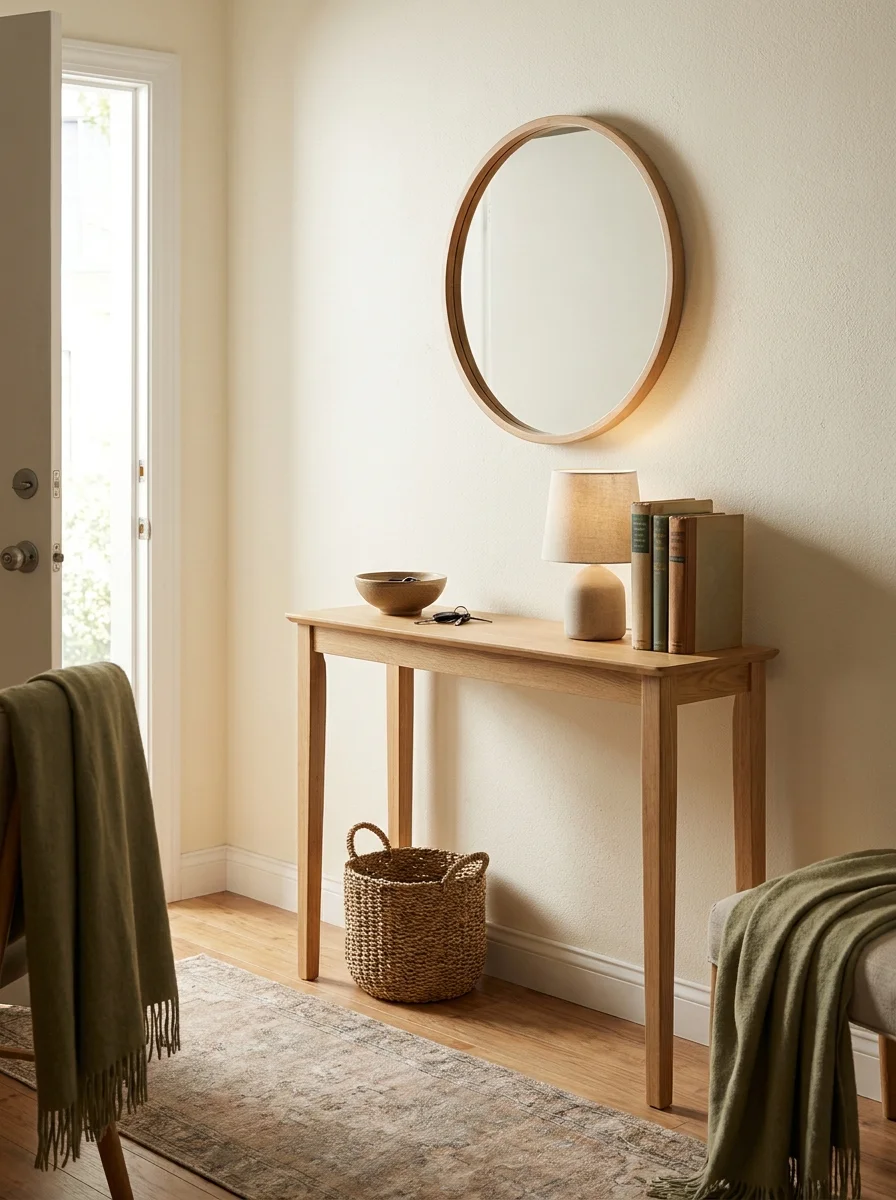
23 Entryway Storage Ideas That Keep Clutter Under Control
Discover practical entryway storage ideas for shoes, coats, bags, keys, and everyday clutter, including smart solutions for small entrances, apartments, and narrow hallways.
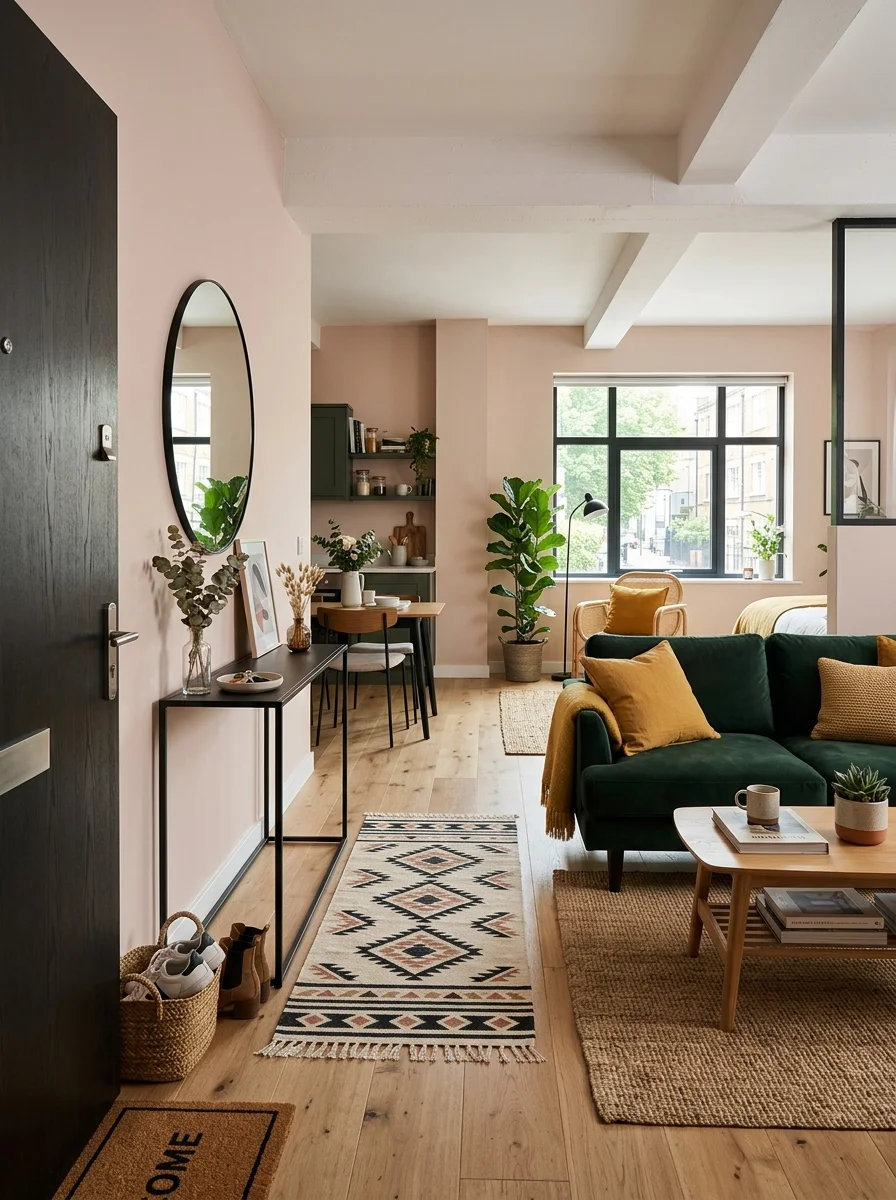
Apartment Entryway Ideas for a More Welcoming Entrance
Make an apartment entrance feel welcoming with practical entryway ideas for storage, furniture, lighting, mirrors, narrow spaces, and renter-friendly decorating.
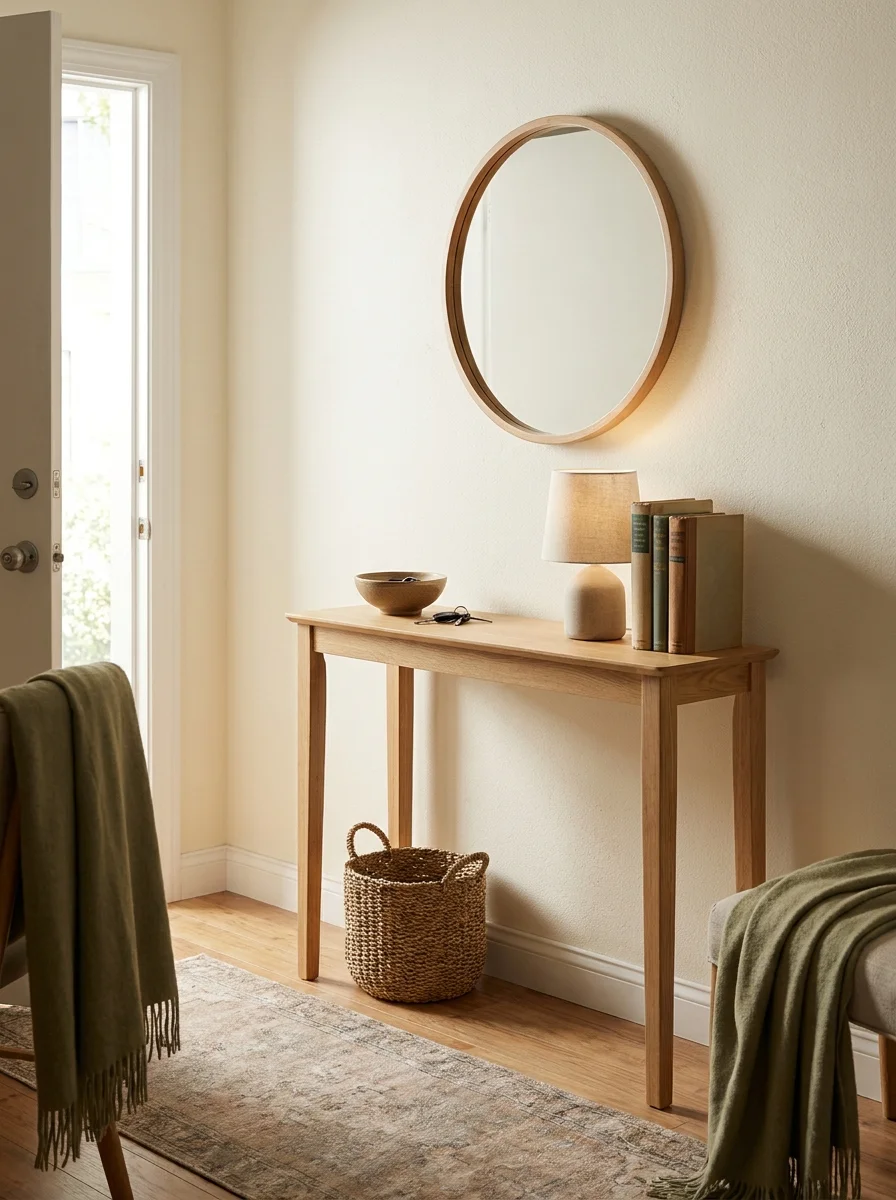
21 Small Entryway Ideas That Make Every Inch Work
Make the most of a small entrance with these practical small entryway ideas for storage, furniture, mirrors, lighting, and stylish everyday organization.
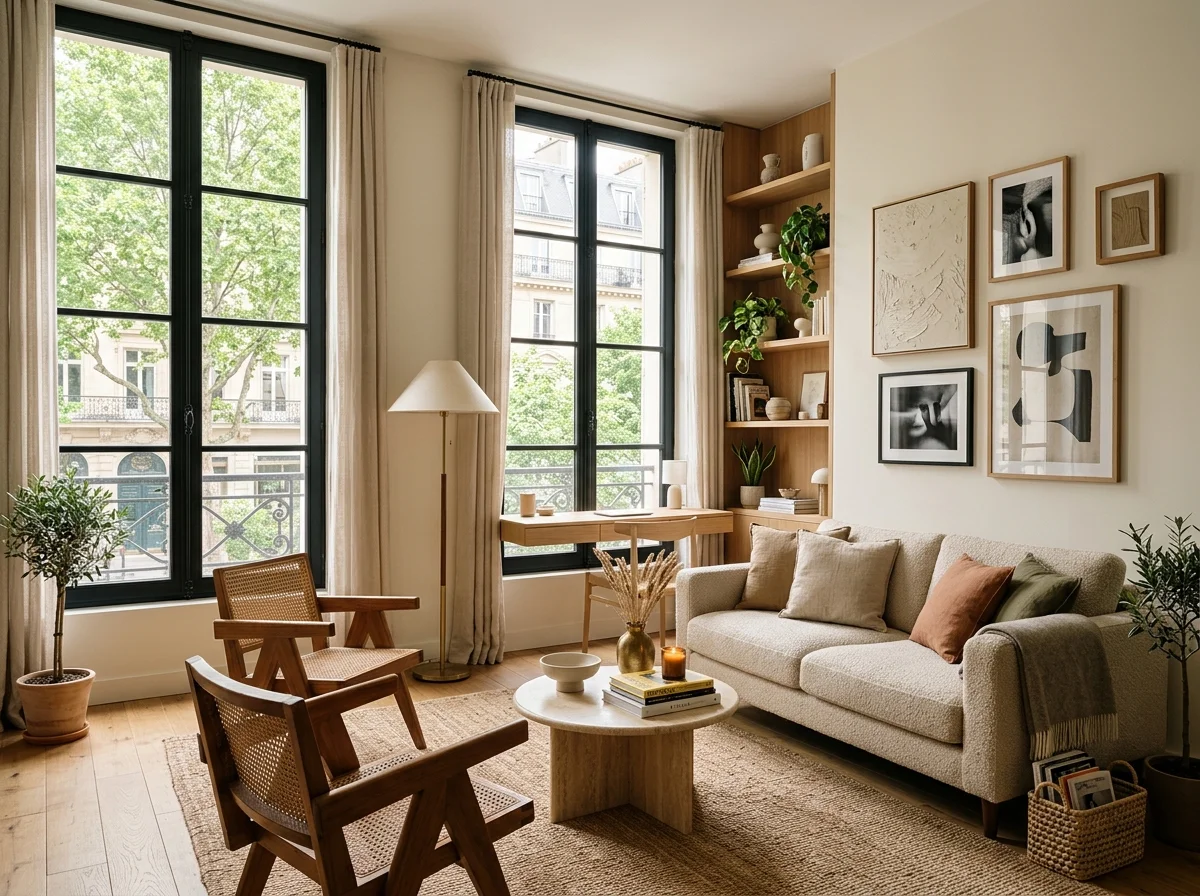
21 Small Space Ideas That Make a Home Feel Bigger
Make a small home feel more spacious and functional with these practical small space ideas for furniture, storage, layout, lighting, and everyday living.